



A Sweet Discovery in a Cosmic Cloud
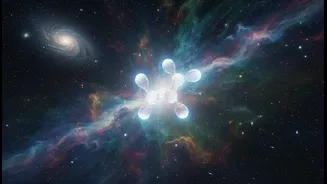
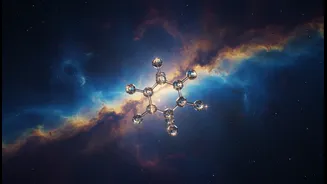
In a breakthrough for astrobiology, an international team of scientists has detected a sugar molecule for the first time in interstellar space. The molecule, called erythrulose, is a four-carbon sugar that on Earth is found naturally in fruits like raspberries.
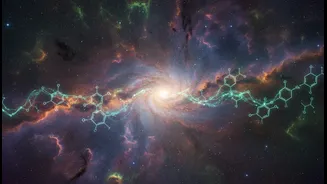
This cosmic sugar was identified in a giant molecular cloud known as G+0.693−0.027, located roughly 27,000 light-years away, near the supermassive black hole at the center of the Milky Way. Using powerful radio telescopes in Spain, researchers matched the faint signals coming from the cloud with the unique radio fingerprint of erythrulose measured in a laboratory. While not life itself, this finding is significant because sugars are fundamental to biology, forming parts of DNA and RNA and playing a vital role in metabolism.
The Galaxy's Chemical Factory
The discovery was made in a region that acts as a vast and turbulent chemical factory. The galactic center is a chaotic place, home to intense radiation, powerful stellar winds, and countless forming stars. The specific location, a molecular cloud, is a cold, dense concentration of gas and dust that provides the raw materials for new stars and planets. For years, this region, and others like Sagittarius B2, have been known to be rich reservoirs of complex organic molecules. Scientists have previously found precursors like alcohols and esters, but finding a true sugar like erythrulose demonstrates that the chemical complexity needed for life can arise even in one of the galaxy's most extreme environments. This suggests that the processes that lead to prebiotic molecules are robust and widespread.
From Cosmic Dust to Building Blocks
So, how does a sugar molecule in deep space connect to the origins of life on a planet like Earth? The leading theory is that billions of years ago, comets and asteroids bombarded the young Earth, delivering a cocktail of water and organic compounds that had formed in interstellar space. This cosmic delivery may have seeded our planet with the essential building blocks, including sugars and amino acids, that were necessary for life to emerge from the primordial soup. Discoveries of sugars and other complex molecules in meteorites on Earth have long supported this hypothesis. Finding erythrulose floating in a star-forming cloud strengthens this link, showing that these crucial ingredients are available in the very places where new planetary systems are born.
What This Means for the Search for Life
This discovery does not mean scientists have found alien life. Rather, it significantly bolsters the idea that the potential for life is not a fluke confined to our solar system. If the basic chemical ingredients for life—sugars, amino acids, and other organic compounds—are commonly produced throughout the galaxy, it increases the statistical probability that life could have started on other Earth-like planets. Every time astronomers find one of these prebiotic molecules in space, it adds another piece to the puzzle. It suggests that the chemical evolution that occurred on early Earth may not be unique, but part of a universal process. The universe, it seems, is naturally equipped to create the very molecules that, under the right conditions, can lead to living organisms.