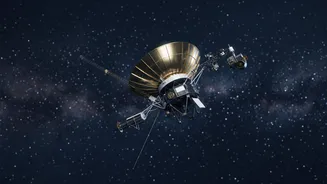






On November 18, a human-made object launched nearly 50 years ago will be a full light-day from Earth. Voyager 1 continues to redefine distance, so what does this milestone for the venerable space probe actually mean for us back home?
A New Cosmic Yardstick
First, let's talk
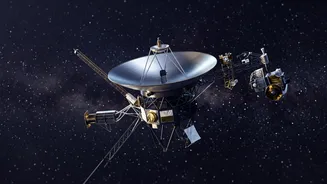
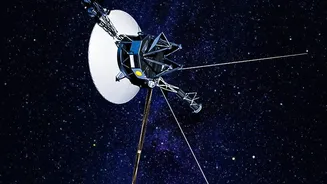
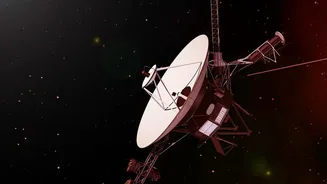
about the incredible scale of this achievement. A light-day is the distance light travels in 24 hours. At a speed of roughly 300,000 kilometres per second, that comes out to a staggering 25.9 billion kilometres. For perspective, light from our own Sun takes a little over eight minutes to reach Earth. When Voyager 1 crosses this threshold, it will be the first object made by humanity to venture so far. The milestone on November 18, 2026, is fundamentally about communication. Radio waves travel at the speed of light, so on that day, it will take a full 24 hours for a command from NASA's Deep Space Network to reach the probe, and another 24 hours to receive a reply. A simple 'hello' and its answer will become a 48-hour conversation.
From Grand Tour to Interstellar Space
Launched on September 5, 1977, Voyager 1 was part of a mission to explore the outer solar system. It flew past Jupiter in 1979 and Saturn in 1980, using their gravity to slingshot itself to incredible speeds. Its observations revolutionized our understanding of these gas giants and their moons, discovering active volcanoes on Io and the complexities of Saturn's rings. After its planetary encounters, its trajectory took it out of the plane of the solar system. In August 2012, it made history by crossing the heliopause—the boundary where the Sun's magnetic field and solar wind give way to the interstellar medium. It had officially entered the space between the stars, a ghost ship sailing an unimaginably vast ocean, currently cruising at over 61,000 kilometres per hour.
A Ghost in the Machine
Keeping a nearly 50-year-old spacecraft functioning is a monumental task. The probe's power comes from radioisotope thermoelectric generators, which have been slowly decaying, losing about four watts of power per year. Mission engineers have become experts in energy conservation, recently performing a tricky power-saving upgrade to extend the life of its remaining scientific instruments. The mission has also had recent scares. In October 2026, NASA briefly lost contact with the probe for 48 hours before the signal was restored, with engineers tracing the issue to a set of thrusters. This came after a more prolonged issue in late 2023 and 2024, where a faulty memory chip sent back gibberish until engineers devised an ingenious long-distance fix. Each problem solved is a testament to the team's dedication.
The Long Goodbye
For Voyager 1, this milestone is purely symbolic; the spacecraft will not feel a thing as it crosses this imaginary line. It will continue its journey, currently aimed in the general direction of a faint star named Gliese 445, which it will pass in about 40,000 years. Eventually, its power will fade completely. NASA anticipates its scientific operations will become increasingly limited, with the potential to return some engineering data until perhaps 2036. After that, it will fall silent, but its journey will not end. It carries on its side a 'Golden Record', a 12 inch gold plated copper disk containing sounds and images selected to portray the diversity of life and culture on Earth. This message in a bottle is for any advanced civilization that might one day encounter it, a silent ambassador from a world far away and long ago.