



The Kayak Stroke: A Rotational Powerhouse
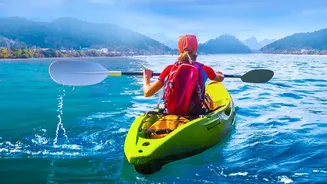
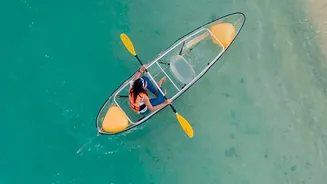
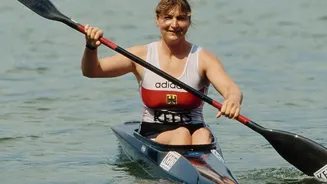
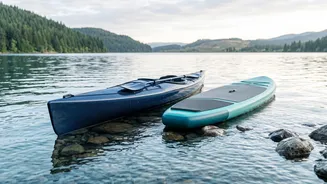
At first glance, kayaking seems like an arm-dominant activity. However, proper technique relies on power generated from your core and back. The fundamental kayaking stroke is a rotational movement. As you sit in the kayak, you plant the paddle blade in the water
and then rotate your torso to pull the boat forward. This twisting motion is where the real work happens. The primary back muscles engaged are the latissimus dorsi, or 'lats'—the large, V-shaped muscles that span the width of your back. Each pull on the paddle is a powerful contraction for your lats. Assisting them are the rhomboids and trapezius muscles in your upper back, which help stabilize the shoulder blades and contribute to the pulling motion. Think of your torso as the engine; your arms are simply the transmission, connecting that engine to the paddle. This is why seasoned kayakers can paddle for hours without their arms fatiguing—they let their larger, stronger back and core muscles do the heavy lifting.
The Paddleboard Stroke: A Stabilising Pull
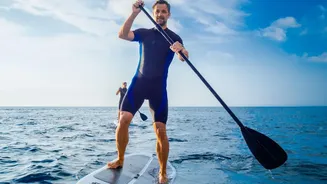
Stand-up paddleboarding presents a completely different physical challenge. The most immediate demand is balance. Simply standing on the board on water forces countless small muscles in your legs, core, and back to fire constantly to keep you stable. The back muscles play a crucial role here, particularly the erector spinae group that runs along your spine, working to keep your posture upright. When it comes to the stroke itself, the mechanics are very different from kayaking. A proper SUP stroke involves hinging at the hips, reaching forward with the paddle, planting it vertically in the water, and then pulling your body towards the paddle—not pulling the paddle past your body. This motion heavily recruits the lats, similar to kayaking, but also requires immense core engagement to transfer power from the paddle, through your body, and to the board. Your abs, obliques, and lower back muscles work in unison to create a stable platform for this powerful pull.
Key Differences: Rotation vs. Full-Body Stability
The main difference in back muscle usage comes down to rotation versus stabilization. Kayaking is fundamentally a seated, rotational exercise. It isolates and builds powerful upper and mid-back 'pulling' muscles, especially the lats and rhomboids, through a twisting motion. Your core is engaged to facilitate this rotation. Stand-up paddleboarding is a full-body stability exercise. While the lats are also engaged in the pull, there's a much greater emphasis on the stabilizing muscles of the entire posterior chain—from your upper back down to your glutes and hamstrings. The lower back muscles, or erector spinae, work overtime on a paddleboard to maintain posture and support the hip hinge, a movement less prominent in kayaking. In short, kayaking is fantastic for developing rotational power and upper-back strength. SUP is superior for building integrated core strength, balance, and endurance in the postural muscles along your entire spine.
Which is Better for You?
Neither sport is inherently 'better'—they simply serve different fitness goals. If your aim is to build a powerful and defined upper back and you enjoy a seated, rhythmic workout, kayaking is an excellent choice. The focused engagement of the lats and surrounding muscles delivers a targeted strength workout. If you're looking for a comprehensive, full-body workout with a heavy emphasis on core strength, balance, and postural endurance, stand-up paddleboarding is hard to beat. It challenges your stability from head to toe and is particularly effective at strengthening the deep core and back muscles that support a healthy spine. For both activities, proper form is crucial to maximize benefits and prevent injury. Leaning too heavily on your arms in either sport is a recipe for fatigue and potential strain. The key is always to connect with your core and let those larger muscles power your movement.