



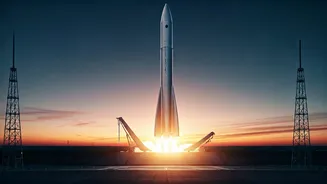


Artemis II: Humans Circle the Moon
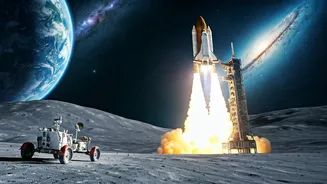
The headline event of the year is undoubtedly NASA's Artemis II mission, slated to send four astronauts on a flyby of the Moon. [13, 15] This will be the first time humans have ventured beyond low-Earth orbit since the Apollo 17 mission in 1972. [6] The approximately
10-day flight will see the Orion spacecraft loop around the Moon, testing life support, navigation, and communication systems with a crew aboard for the first time in deep space. [13] While not a landing, this mission is a critical step, validating the hardware for future crewed landings and gathering vital data on astronaut health and spacecraft performance. [13, 19] The crew includes three American astronauts and one Canadian, marking a new era of international cooperation in lunar exploration. [15]
A Flurry of Robotic Moon Visitors
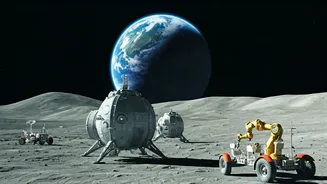
While Artemis II carries the human element, a host of robotic missions will be busy on and around the Moon. China's Chang'e-7 is scheduled to launch for the lunar south pole, a region of intense interest due to signs of water ice in permanently shadowed craters. [1, 6] The mission includes an orbiter, lander, and rover designed to hunt for these frozen resources. [1, 11] Joining the lunar rush are several commercial players under NASA's Commercial Lunar Payload Services (CLPS) initiative. Landers from companies like Blue Origin, Astrobotic Technology, and Intuitive Machines are all targeting launches in 2026, carrying a variety of scientific and technological payloads. [6] Blue Origin, for instance, plans a demonstration of its Mark 1 lander near Shackleton Crater. [11]
Hera Arrives to Inspect a Battered Asteroid
In a fascinating chapter of planetary defense, the European Space Agency's (ESA) Hera mission is scheduled to arrive at the Didymos-Dimorphos binary asteroid system in late 2026. [2, 3] This is a follow-up to NASA's DART mission, which successfully slammed a spacecraft into the smaller asteroid, Dimorphos, in 2022 and changed its orbit. [3] Hera will act as a cosmic detective, surveying the impact site, measuring Dimorphos's mass, and studying its internal structure. [1] This will provide invaluable data on the effectiveness of kinetic impactors, a key technology for defending Earth from potential asteroid threats. [3] The mission will be the first to fully characterize a binary asteroid system. [2]
Deep Space Encounters and New Departures
The action in 2026 extends far beyond the Moon. The joint ESA-JAXA BepiColombo mission is expected to finally arrive at Mercury after an eight-year journey, deploying two orbiters to study the solar system's most overlooked rocky planet. [1] Meanwhile, Japan's Martian Moons Exploration (MMX) mission is set to launch in November 2026. [1] It will attempt the audacious goal of landing on Mars's moon Phobos and returning a sample to Earth to help solve the mystery of how the Martian moons formed. [1] Also in 2026, the Europa Clipper spacecraft, launched in 2024, will perform a crucial Earth gravity-assist flyby in December, slinging it on its path toward Jupiter's ocean moon, where it will arrive in 2030. [5, 8, 9]
The Shifting Landscape of Mars Exploration
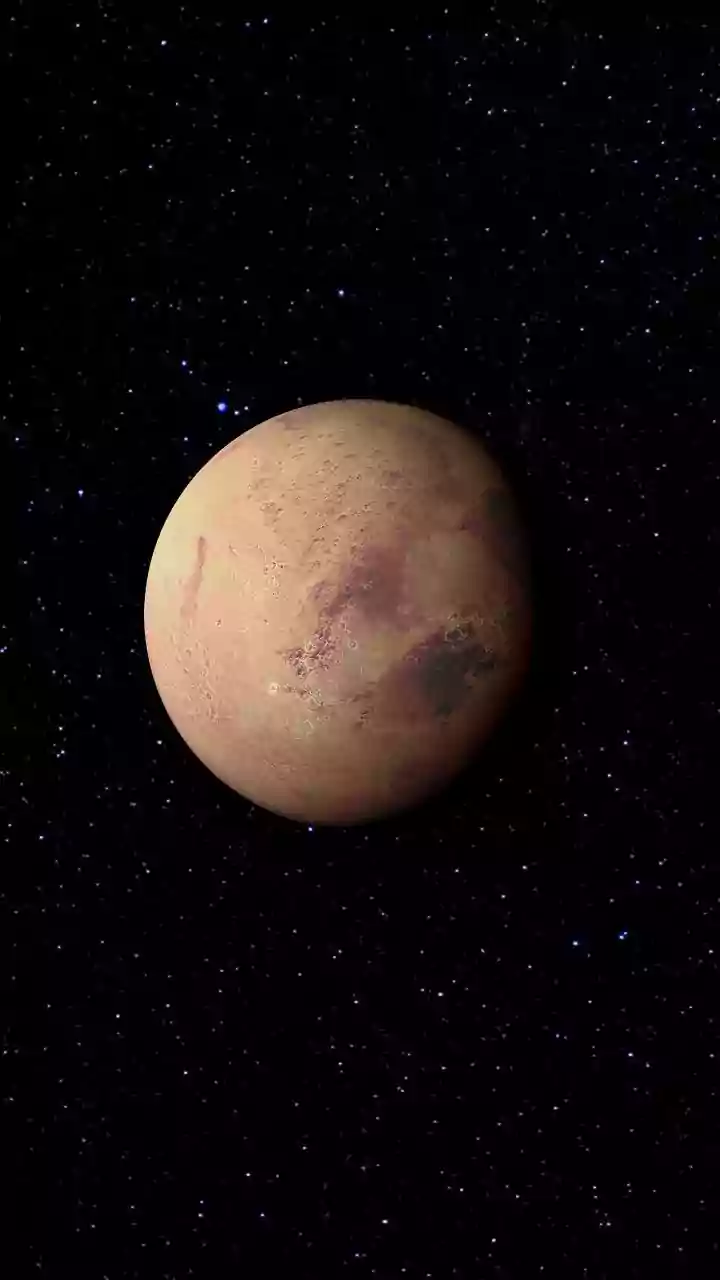
The highly anticipated Mars Sample Return (MSR) mission, a joint effort by NASA and ESA, will reach a critical decision point in 2026. [26, 28] While the Perseverance rover continues to collect and cache compelling rock samples on the Martian surface, NASA has stated it will finalize the architecture for retrieving them by mid-2026. [26, 29] The mission has faced significant budget and timeline reviews, and the new plan will determine the precise strategy for launching a lander and ascent vehicle to collect the samples and rocket them into orbit for their journey back to Earth, with a return now targeted for the mid-to-late 2030s. [26, 30] This decision will set the stage for one of the most complex robotic undertakings ever attempted.