


The Great Cosmic Scramble
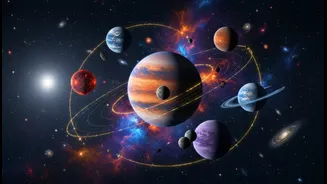
Imagine a brand-new solar system as a furious cosmic demolition derby. In the early days, dozens or even hundreds of planetary embryos and smaller bodies called planetesimals orbit a young star in a crowded, dusty disk. According to the laws of gravity,
every object pulls on every other object. In such a congested environment, this isn't a gentle waltz; it's a mosh pit. This intense gravitational tug-of-war is what astronomers call 'gravitational competition'. Planets on unstable paths can have their orbits drastically altered. Some might collide and merge with others, growing larger in the process. Many others, however, can be unceremoniously ejected from the system entirely, destined to become 'rogue planets' wandering alone in the vast emptiness of interstellar space. This process is a fundamental part of how solar systems evolve, a true survival-of-the-fittest contest played out on a celestial scale.
A Puzzling Stability
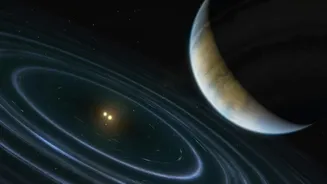
Given this chaotic beginning, one might expect stable, multi-planet systems like our own to be a rarity. Yet, as our telescopes have become more powerful, we have discovered thousands of exoplanetary systems, and many of them are surprisingly crowded. Some systems feature multiple large planets orbiting their star in configurations that appear, on paper, to be precariously balanced. They are so tightly packed that even a small disturbance should, in theory, send them spiralling into chaos. This presented a major puzzle for astronomers: if the early years are so violent, how do so many of these intricate and seemingly fragile systems survive for billions of years? It seemed unlikely that they were all just on the verge of collapse, suggesting some powerful stabilizing force was at play.
Order From Apparent Chaos
The solution to the puzzle seems to be that complexity itself can be a source of stability. A key mechanism is something called orbital resonance. This occurs when the orbits of two planets are in a simple integer ratio. For example, for every one orbit an outer planet makes, an inner planet might make exactly two or three. The result is that the planets give each other the same gravitational nudge at the same point in their orbits, over and over again. Instead of random, destabilizing pulls, resonance creates a predictable, rhythmic pattern. This repeating interaction can lock planets into their orbits, preventing them from straying and disrupting the system. Far from being a source of chaos, this complex gravitational timing acts like a celestial shepherd, corralling the planets and ensuring long-term stability.
A System Filled to Capacity
But complexity is more than just resonance. The entire architecture of a planetary system contributes to its stability. This includes the number of planets, their respective masses, their spacing, and even the presence of other features like asteroid belts. Modern computer simulations allow astronomers to model the late stages of planet formation, testing countless starting configurations. These models suggest that many systems likely started with even more planets. Over millions of years, the most unstable members were ejected until the system settled into what scientists call a 'dynamically packed' state. This is the most complex configuration possible that can remain stable over the long term. In this view, a system's complexity isn't a bug; it's a feature. The intricate web of gravitational checks and balances between all its members is precisely what allows it to endure.
Lessons for Our Own Backyard
This evolving understanding has profound implications for how we view our own solar system and the search for life elsewhere. The current arrangement of our planets, including the gravitational influence of giants like Jupiter and the presence of the asteroid belt, is not an accident. It is the result of billions of years of gravitational sculpting that left our system in a state of long-term, complex stability. When searching for exoplanets, astronomers are no longer just looking for simple, isolated worlds. They now understand that the presence of multiple, even giant, planets does not necessarily mean instability for a potential Earth-like world. In fact, the complex gravitational dance of a rich planetary system might be a crucial ingredient for creating the stable conditions necessary for life to arise and thrive.