






The Annual Cycle of Damage and Repair
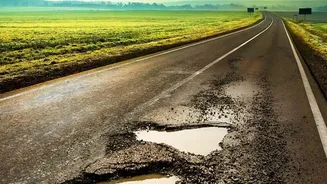
The arrival of the monsoon is a relief from the summer heat, but for commuters, it signals the start of the annual pothole season. Heavy rains weaken and strip away the surface of roads, leading to cracks that quickly evolve into bone-jarring craters.
In 2022 alone, potholes on national highways were responsible for over 4,400 accidents and more than 1,800 fatalities in India. This constant cycle of damage and repair is not just dangerous; it's also incredibly costly. Municipal corporations and highway authorities spend crores of rupees each year on temporary patchwork that often washes away in the next downpour, leading to endless traffic disruption and a significant drain on public funds. This recurring problem has prompted a search for more durable and sustainable solutions, with the National Highways Authority of India (NHAI) actively exploring innovative methods to improve road longevity.
An Introduction to Self-Healing Asphalt
Imagine a road that can fix its own cracks before they become a problem. This is the core idea behind self-healing asphalt. Unlike traditional asphalt that is passive and requires external intervention for repairs, self-healing variants are designed with active repair mechanisms built directly into the material. The technology works by embedding special agents within the asphalt mix. When a micro-crack forms due to traffic stress or weather, these agents are activated, effectively 'healing' the damage from the inside out. This prevents small fissures from growing into large, dangerous potholes. Several approaches exist, but they all share the same goal: to create a smarter, more resilient road surface that can autonomously extend its own lifespan.
The Science of Bio-Engineered Binders
The headline's "bio-engineered binders" refer to one of the most exciting frontiers in this field. These binders often use renewable, plant-based materials to achieve their healing effect. One prominent method involves embedding tiny microcapsules into the asphalt. These capsules, sometimes made from plant spores, contain rejuvenating oils, which can be derived from sources like sunflowers, waste cooking oil, or other forms of biomass. When a crack forms, the pressure breaks the capsules, releasing the oil. This oil then softens the surrounding aged and brittle bitumen (the glue that holds asphalt together), allowing it to flow and rebond, sealing the crack. Researchers are using advanced tools like artificial intelligence to simulate molecular behaviour and optimise these bio-binders for maximum efficiency, aiming to create a material inspired by the natural healing processes found in plants and animals.
How It Works in Practice
While bio-binders are a key innovation, other methods also exist. One of the earliest and most tested approaches, pioneered at Delft University, involves mixing small steel fibres into the asphalt. When cracks appear, a special vehicle passes over the road, using an induction machine to create a magnetic field. This heats the steel fibres, which in turn melt the surrounding bitumen just enough for it to flow into the cracks and seal them. Another similar method uses iron oxide nanoparticles that heat up when exposed to a magnetic field. A hybrid approach even combines induction heating with encapsulated rejuvenators, using heat to close the crack and the released oil to replenish the aged binder. Though the activation methods differ, the outcome is the same: a road surface that can be repaired quickly, efficiently, and with far less disruption than traditional roadwork.
Benefits Beyond a Smoother Ride
The most obvious benefit of self-healing roads is the reduction of potholes, leading to safer and more comfortable journeys. But the advantages run much deeper. By extending the lifespan of roads—potentially by up to 30% or more—this technology can drastically reduce long-term maintenance costs. Studies suggest life-cycle costs could be cut by 20-30%. Fewer repairs mean fewer traffic jams caused by construction, saving fuel and time for millions of commuters. There's also a significant environmental upside. Using bio-binders made from waste products like agricultural biomass or recycled oils reduces our reliance on petroleum-based bitumen. Longer-lasting roads mean less need for quarrying new aggregates and producing carbon-intensive asphalt, contributing to a more sustainable infrastructure model.
The Road Ahead for India
While the promise is immense, widespread adoption faces hurdles. The primary challenge is the higher upfront cost; self-healing asphalt can be significantly more expensive to produce than conventional mixes due to the specialised additives. Long-term performance data in diverse and demanding Indian climatic conditions is still needed. However, the potential for long-term savings is compelling, and research is underway within India to adapt these technologies. Institutions like IIT-Madras are experimenting with variants designed for tropical climates and heavy traffic loads. With pilot projects already deployed in countries like the Netherlands and China, and with India's massive investment in its National Infrastructure Pipeline, the stage is set for this technology to move from the lab to our highways.