



A Celestial Calendar for 2026
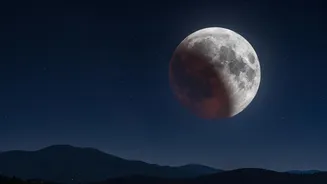
In 2026, two lunar eclipses are on the cosmic schedule. First, a Total Lunar Eclipse will occur on March 3. Later in the year, a deep Partial Lunar Eclipse is set for August 28. A lunar eclipse happens when the Earth positions itself directly between
the Sun and the Moon, casting its shadow on the lunar surface. There are three main types: total, where the entire Moon enters Earth's darkest shadow (the umbra); partial, where only a part of the Moon enters the umbra; and penumbral, where the Moon passes through Earth's fainter outer shadow. For viewers, this distinction is crucial, as total and partial eclipses are dramatic events, while penumbral eclipses can be so subtle they are hard to notice.
March 3: A Total Lunar Eclipse
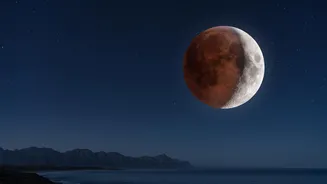
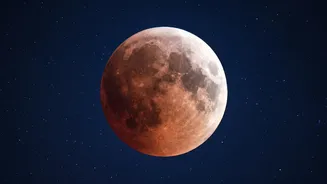
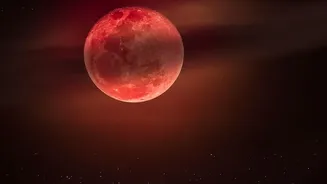
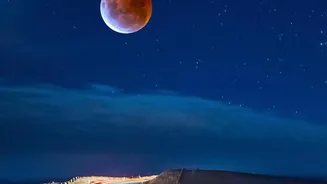
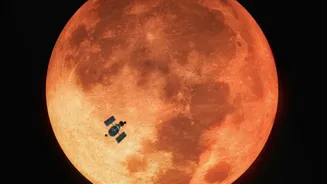
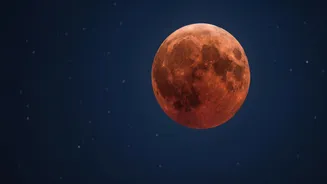
The first event of the year is a Total Lunar Eclipse on March 3, 2026, an event that coincides with the festival of Holi. During a total eclipse, the Moon can take on a reddish hue, often called a "Blood Moon." This happens because sunlight filters through Earth's atmosphere, which scatters blue light and leaves red light to illuminate the Moon. However, visibility across India will be tricky. The eclipse will already be in progress as the Moon rises in the evening. This means most of India will only witness the partial phases of the eclipse as it ends. The best views will be in the northeastern states and the Andaman and Nicobar Islands, where the end of the total phase might be visible just after moonrise. For many, it will be a race against twilight to catch the spectacle.
Visibility and Timings for the March Eclipse
According to the Ministry of Earth Sciences, the eclipse will begin around 3:20 PM IST and end by 6:48 PM IST. The period of totality, when the Moon is fully engulfed in Earth's shadow, is from 4:34 PM to 5:33 PM IST. Since the Moon will rise at different times across the country (for example, after 5:40 PM in many cities), most observers will see an already-eclipsed Moon ascending on the eastern horizon. This is known as a Grastodaya eclipse. While western parts of the country might miss the main event, cities in the east like Guwahati and Aizawl will have a better, though brief, opportunity to see the total or deep partial phase.
August 28: A Deep Partial Lunar Eclipse
The second event, a Partial Lunar Eclipse on August 28, 2026, is a significant astronomical event where nearly 96% of the Moon will be covered by Earth's umbra. While this promises a spectacular sight, unfortunately, it will not be visible from India. The entire eclipse, from its beginning around 6:53 AM IST to its end at 12:32 PM IST, occurs during daylight hours for the subcontinent. The maximum eclipse is timed for 9:43 AM IST, when the Moon will be below the horizon. This event will be best viewed from North and South America, with partial visibility in western Europe and Africa.
How to Get the Best View
For the visible March 3 eclipse, preparation is key. The good news is that lunar eclipses are perfectly safe to watch with the naked eye, unlike solar eclipses. To maximize your experience, find a location with a clear, unobstructed view of the eastern horizon. Rooftops or open fields away from bright city lights are ideal. Although no special equipment is required, binoculars or a small telescope can dramatically enhance the view, revealing details on the lunar surface and the beautiful coppery colours during the deeper phases of the eclipse. Remember to check the local weather forecast, as clear skies are essential. Dress for the weather and give your eyes a few minutes to adjust to the darkness.