







Forget 'Emptying Your Mind'
The single biggest myth that makes meditation feel daunting is the idea that you must stop thinking completely. This is not only difficult, it's nearly impossible. Our brains are designed to think. The goal of meditation isn't to create a mental void,
but rather to change your relationship with your thoughts. It's about learning to observe them without getting carried away. Think of it like sitting by the side of a road; you are not trying to stop the traffic, you are simply watching the cars go by. When a thought about your to-do list or an awkward conversation appears, the practice is to notice it, acknowledge it without judgment, and gently return your focus to your anchor, such as your breath. Each time you guide your mind back is a small victory, not a sign of failure.
Redefine Your Idea of Success
Success in meditation shouldn't be measured by how long you can sit still or how few thoughts you have. Instead, success is about the utility it brings to the rest of your day. Did the practice help you feel a little less reactive in traffic? Did you notice a moment of calm before a stressful meeting? These are the real-world benefits. The point is not to become a 'good meditator', but to use meditation to become more present and effective in your life. Shifting the goal from in-session perfection to real-world usefulness removes the pressure and turns it into a practical self-care tool rather than another task to fail at.
Start Small, Even Just for a Minute
The belief that you need a special cushion, a silent room, and a free hour is a major barrier for many. The truth is, even a minute of mindful breathing can be beneficial. Research increasingly shows that the consistency of the practice is more important than the duration of each session. You can practice for five minutes while waiting for your morning chai to brew, or take a few deep, conscious breaths at your desk between tasks. One study found that daily 13-minute sessions improved attention and memory. These 'micro-meditations' are less intimidating and easier to integrate into a busy schedule, making you more likely to stick with them. By starting small, you build the habit without feeling overwhelmed.
Find a Simple Anchor
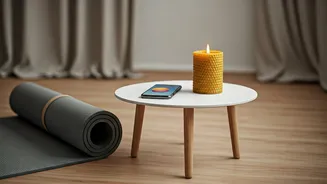
You don't need complex techniques or Sanskrit mantras to begin. All you need is a simple point of focus, often called an anchor, to return to when your mind wanders. The most accessible anchor for anyone, anywhere, is the breath. Simply pay attention to the physical sensation of the air entering your nostrils and filling your lungs, and the feeling of it leaving your body. If the breath doesn't work for you, you can focus on sounds around you, the feeling of your feet on the ground, or even the flame of a candle. There is no right or wrong anchor; the key is to find something that helps you gently tether your attention to the present moment, making the practice feel concrete and manageable.
Notice the Off-the-Cushion Benefits
The true utility of meditation reveals itself not while you are sitting with your eyes closed, but in your daily interactions. After practicing for a while, you might notice that you are less likely to be irritated by small annoyances. You might find you can focus on a task for longer, or that you are a better listener in conversations. These are the markers of a 'successful' practice. It’s not about achieving a mystical state, but about improving your well-being, enhancing self-awareness, and fostering emotional regulation. Paying attention to these small, positive shifts in your everyday life provides the motivation to continue. The practice stops being a chore and becomes a valuable resource for navigating life with greater ease and clarity.