






An Icy Moon with a Potent Secret
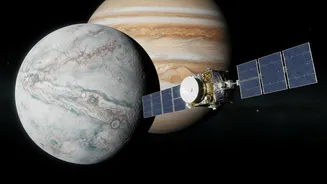
Slightly smaller than Earth’s own moon, Europa is one of Jupiter's largest satellites, discovered by Galileo Galilei in 1610. What makes it a prime target for astrobiologists is the overwhelming evidence that a vast saltwater ocean is hidden beneath its
icy crust. This isn't a small sea; scientists estimate it could contain more than twice the amount of water found in all of Earth's oceans combined. The moon's surface is a landscape of cracks and streaks, suggesting a dynamic world where the icy shell shifts and fractures. This activity is driven by tidal heating—the constant stretching and compressing from Jupiter's immense gravity generates heat, keeping the ocean below from freezing solid. This process could also create hydrothermal vents on the seafloor, similar to those on Earth that teem with life, providing both chemical nutrients and energy in the absence of sunlight.
Meet the Clipper: A Robotic Investigator
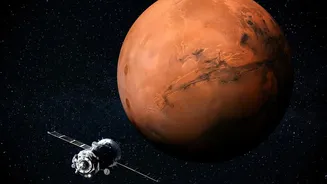
The Europa Clipper is NASA's largest interplanetary spacecraft, a sophisticated robotic explorer designed for a singular purpose: to determine if Europa has the ingredients necessary for life. Launched in October 2024, it is now on a long and winding 2.9-billion-kilometre journey to the Jupiter system. To get there, it will perform a Mars-Earth gravity assist, swinging by Mars in early 2025 and then back past Earth in late 2026 to gain the speed needed for its interplanetary trek. It is scheduled to arrive in orbit around Jupiter in April 2030. The spacecraft won't orbit Europa directly due to the intense radiation from Jupiter, which could damage its electronics. Instead, it will orbit Jupiter and perform dozens of close flybys of the moon, some as low as 25 kilometres above the surface. This strategy allows the Clipper to scan nearly the entire moon while minimizing its exposure to harmful radiation.
How to Map an Ocean from Space
The Clipper is equipped with a powerful suite of nine science instruments designed to peek beneath the ice without ever touching down. Its ice-penetrating radar will map the thickness of the icy shell and search for pockets of water, or even lakes, that may exist within it. A magnetometer will measure the magnetic field around Europa; distortions in this field will help confirm the existence, depth, and saltiness of the global ocean. Other instruments, including high-resolution cameras and spectrometers, will produce detailed maps of the surface and analyse its chemical composition. Scientists will be particularly eager to spot any plumes of water vapour that might be erupting from cracks in the ice. If the Clipper can fly through one of these plumes, its MAss Spectrometer for Planetary EXploration (MASPEX) instrument could directly analyse the chemical makeup of the ocean below, sniffing out potential biosignatures.
Searching for Clues, Not Creatures
It's important to note that Europa Clipper is not a life-detection mission; its goal is to determine habitability. This means it's looking for the conditions and ingredients that could support life as we know it: liquid water, the essential chemical elements (like carbon, hydrogen, and oxygen), and an energy source. The mission will not be sending back images of alien fish. Instead, it will search for complex organic molecules or other chemical clues—known as biosignatures—that might suggest the presence of biological processes. Finding these ingredients would be a monumental discovery, suggesting that the building blocks for life exist in this distant ocean. Whether life ever actually began there is a question that will likely require a future lander mission. For now, the Clipper's primary job is to provide the most detailed reconnaissance of an alien ocean world ever attempted.