



First Off, Is It Really a Million?
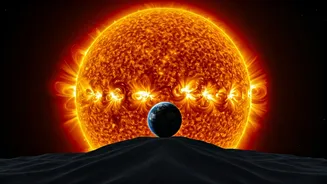
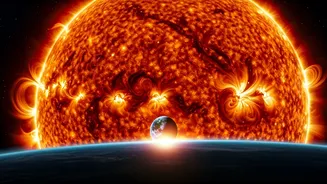
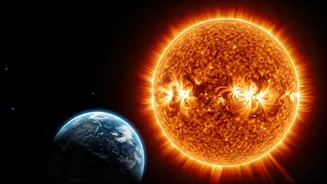
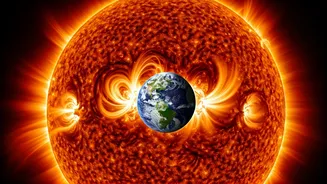
Let’s get the math out of the way. The headline is actually a bit of an understatement. The most common calculation suggests that you could fit approximately 1.3 million Earths inside the sun. The number comes from comparing the volumes of the two celestial
bodies. The sun’s diameter is about 864,000 miles, while Earth’s is a mere 7,917 miles. This means the sun is about 109 times wider than our planet. But when you’re talking about volume—the amount of three-dimensional space an object occupies—that difference becomes truly immense. You don’t just line up 109 Earths side-by-side. You’re filling a giant sphere with tiny spheres. Because the volume of a sphere is calculated using the cube of its radius (V = 4/3πr³), that 109-times-wider factor gets cubed (109 x 109 x 109). The result? Just over 1.3 million. So, when you hear “a million Earths,” know that it’s a rounded-down figure designed to be memorable. The reality is even more staggering.
Let's Make the Size Tangible
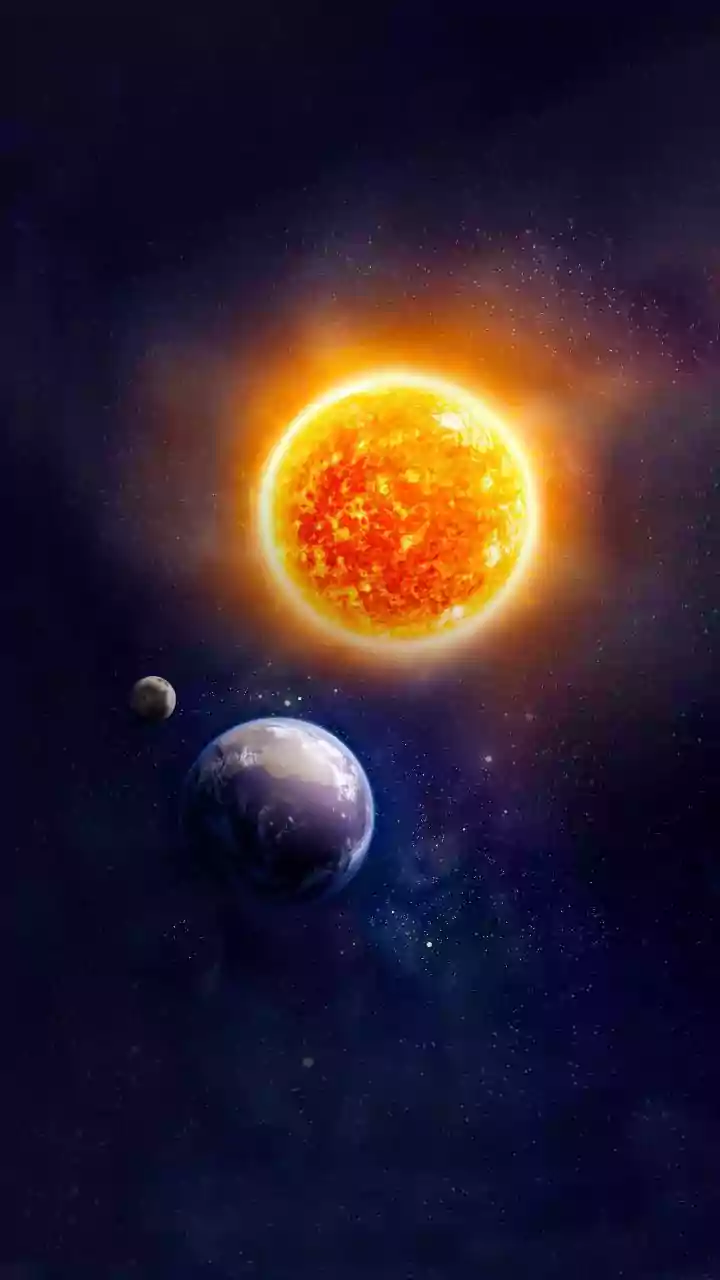
Numbers like 1.3 million are still too abstract. To truly feel the scale, we need analogies. Imagine our planet Earth is a single green pea. At that scale, the sun wouldn’t be a basketball or even a yoga ball. It would be a colossal sphere about nine feet in diameter, the size of a small room. Now, imagine 1.3 million of those green peas filling that nine-foot sphere. That’s the relationship. Here’s another way to think about it. If you were on a commercial jet flying at a steady 550 miles per hour, it would take you about two and a half weeks to circumnavigate the Earth. That same jet, flying at the same speed, would need more than five months just to fly in a straight line from one side of the sun to the other. To circle the sun’s equator? You’d be on that plane for over a year and a half. The sheer physical space our star occupies is almost beyond human intuition.
It's Not Just Big, It's Heavy
Volume is one thing, but mass is another. The sun isn’t just an enormous, empty container; it's a fantastically dense ball of superheated plasma. In fact, the sun is so massive that it accounts for a staggering 99.86% of all the mass in our entire solar system. Everything else—all eight planets (including the gas giants Jupiter and Saturn), all the asteroids, all the comets, every moon, and every speck of dust—makes up the remaining 0.14%. Think about that. Our entire solar system, a structure so vast it takes decades for our fastest probes to cross, is almost entirely composed of one object. The Earth, which feels so solid and immense beneath our feet, is just a tiny, almost negligible fleck of cosmic dust when compared to the gravitational anchor that holds our neighborhood together. Every other body in the solar system is essentially a rounding error in the sun’s colossal mass budget.
A Small Giant in a Big Galaxy
Here’s the final twist that can really break your brain: on a galactic scale, our sun is… pretty average. It's a G-type main-sequence star, or a yellow dwarf. It's respectably sized, but it's no heavyweight champion. Astronomers have discovered stars that make our sun look like Earth in comparison. Take a star like UY Scuti, a red hypergiant. If you were to place UY Scuti where our sun is, its surface would extend out past the orbit of Jupiter. It is so gargantuan that you could fit hundreds of millions of our suns inside of it. Or consider Betelgeuse, the famous red star in the Orion constellation. It's “only” about 700 times wider than our sun, but that still means millions of suns could fit within its volume. This doesn’t diminish our sun; it just recalibrates our understanding of the universe. Our neighborhood star, the one that can hold 1.3 million Earths, is just a middling player in a cosmos filled with true monsters.