






A 'One in a Million' Discovery
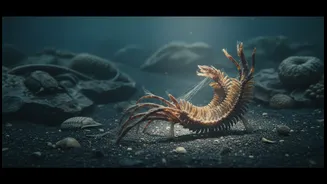
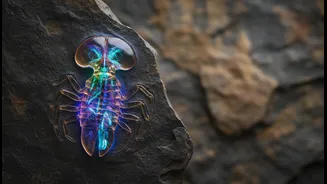
Paleontologists are celebrating an exceptionally rare find: the fossil of a 450-million-year-old crinoid with its soft tissues still intact. Crinoids, ancient relatives of modern starfish, resembled sea flowers and were abundant in Earth's earliest marine
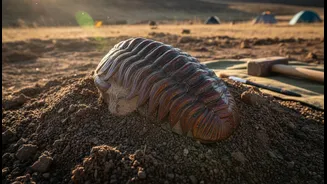
ecosystems during the Ordovician period. While millions of crinoid fossils have been found, this is only the second time soft tissue has ever been discovered, and it is by far the oldest example. The fossil, identified as Dendrocrinus simcoensis, was found not on a dramatic expedition, but sitting in the collection of a small museum in Montreal, its true importance unrecognized for years. The preservation of soft tissue is incredibly rare because structures like skin and organs are the first to decay after death, requiring near-perfect environmental conditions to fossilize.
Rebuilding an Alien World
This fossil isn't just a curiosity; it's a vital clue for reconstructing an ancient world. The intact tissue, specifically the crinoid's 'tube feet,' gives scientists a direct look at the animal's biology. By comparing its anatomy to modern crinoids, researchers have determined that this ancient species likely fed and behaved very differently from its living relatives. This provides new insights into how these early animals evolved and how their feeding strategies changed over hundreds of millions of years. Reconstructing ancient life is like solving a complex puzzle. Scientists use the hard parts of fossils, like bones and shells, to build a basic picture, but preserved soft tissue provides crucial, often game-changing, details about how an organism actually lived and functioned within its ecosystem.
A Time of Explosive Evolution
The fossil dates back to the Great Ordovician Biodiversification Event (GOBE), a period when the diversity of marine life tripled. This era, which followed the more famous Cambrian Explosion, established the complex marine ecosystems that would dominate the oceans for the next 230 million years. The GOBE saw the rise of suspension feeders like crinoids, corals, and brachiopods, creating tiered communities that filtered food from different levels of the water column. This rapid increase in the number and variety of species created more complex and resilient food webs. Studying fossils from this critical time helps scientists understand the fundamental drivers of biodiversity and the origins of modern ecosystems.
Lessons from the Deep Past for Today's World
So, what does this ancient sea creature have to do with us today? This is where paleontology connects with real-world decisions. The field of conservation paleobiology uses the fossil record to establish baselines for modern ecosystems. Many environments today have been so altered by human activity that we have no record of what they looked like in their natural, healthy state. Fossils provide a window into what a thriving ecosystem looked like before human impact, giving conservationists a target for restoration efforts. By understanding how life responded to dramatic environmental shifts in the past—like the ice age that triggered the Late Ordovician Mass Extinction—scientists can better predict how modern species might react to climate change. Fossils show us which species and ecological functions are most vulnerable and which are more resilient, helping to inform conservation strategies.