




A New Generation of Cosmic Explorer
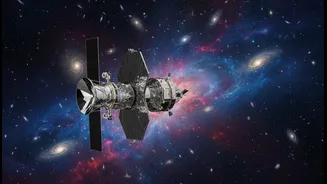
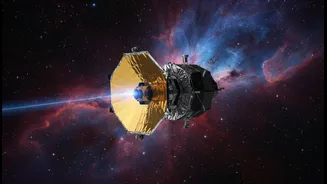
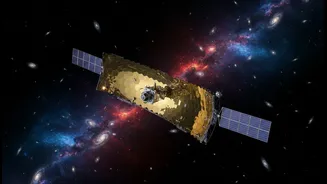
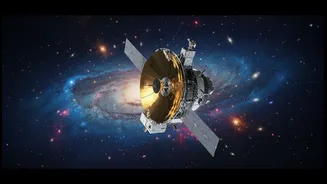
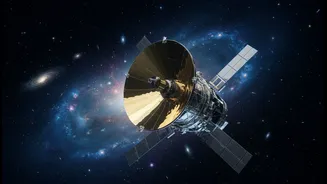
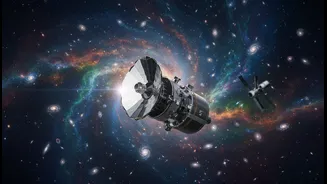
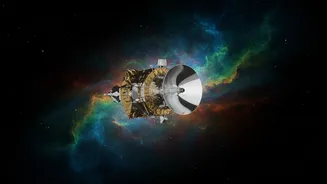
Set for launch in the summer of 2026, the Nancy Grace Roman Space Telescope is NASA's next great observatory. Named after Nancy Grace Roman, the legendary first Chief of Astronomy at NASA known as the “Mother of Hubble,” the telescope honours her legacy
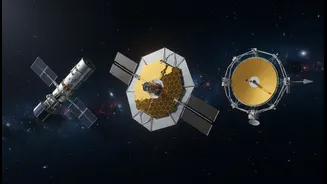
by pushing the boundaries of space-based observation. While Hubble gave us sharp, deep portraits of cosmic objects, Roman is designed for a different, yet complementary, purpose: to create vast panoramas of the universe with the same stunning clarity. It shares a 2.4-meter primary mirror, the same size as Hubble's, but its instrumentation is engineered for a revolutionary new approach to cosmic surveys.
The Power of a Panoramic View
The single most significant advantage Roman has is its incredible field of view. Its Wide Field Instrument can capture an area of the sky at least 100 times larger than Hubble's infrared instrument in a single snapshot. To put that in perspective, where Hubble might need to painstakingly stitch together over 400 individual images to create a mosaic of the neighbouring Andromeda galaxy, Roman could capture the same area in just two. This leap from a keyhole view to a massive picture window will allow astronomers to map huge swaths of the sky with incredible efficiency. This capability will fundamentally change how astronomers can study the structure of the universe, moving from detailed studies of individual targets to massive statistical surveys of billions of cosmic objects.
Tackling the Universe’s Biggest Mysteries
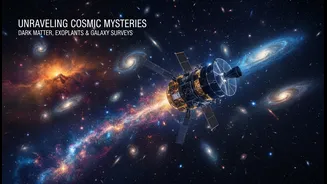
With its vast reach, Roman is designed to tackle two of the most profound questions in modern science: the nature of dark energy and the census of exoplanets. Dark energy is the mysterious force believed to be causing the accelerating expansion of the universe. Roman will study its effects by measuring the distribution of hundreds of millions of galaxies and observing distant supernovae, providing crucial data to test theories about this phenomenon. Simultaneously, the telescope will conduct a massive survey for planets outside our solar system. Using a technique called gravitational microlensing, Roman is expected to find thousands of new worlds, from gas giants to smaller, rocky planets, providing a more complete picture of planetary systems across our galaxy. It is projected to find as many as 100,000 exoplanets during its mission, a monumental increase from the roughly 6,000 confirmed to date.
Successor, Partner, and Trailblazer
So, is Roman a true successor to Hubble? The answer is nuanced. While NASA officials have called it a successor to both Hubble and the James Webb Space Telescope (JWST), it is perhaps more accurately described as a powerful partner that expands on their capabilities. Hubble’s strength lies in its versatility, observing in ultraviolet, visible, and near-infrared light for high-resolution studies of specific objects. Roman focuses on visible and infrared light, sacrificing some of Hubble's focused depth and spectral resolution for unparalleled survey speed. In many ways, Roman will be a discovery engine. It will rapidly scan the sky to identify interesting targets and cosmic events—like ancient black holes shredding stars—which telescopes like Hubble and Webb can then investigate in greater detail. It complements their work by providing the wide-angle context, mapping the cosmic forests while Hubble and Webb study the individual trees.