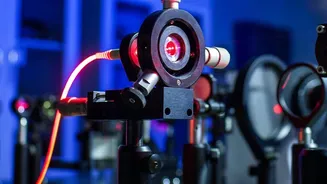







The Chilling Problem with Quantum Tech
Quantum materials are substances with exotic properties that could revolutionize everything from computing and medicine to energy. Their special abilities, however, depend on the strange rules of quantum mechanics. The slightest disturbance, including
the normal heat and vibration of atoms at room temperature, can destroy these delicate quantum effects. To get around this, scientists have had to cool quantum devices to near absolute zero, using bulky, expensive, and energy-hungry cryogenic refrigeration systems. This single requirement has been the biggest barrier keeping world-changing quantum technologies confined to high-end laboratories, making them impractical for everyday use.
A Breakthrough Material Forged from Gold
Recently, a team of physicists has unveiled a material that shatters this long-standing limitation. In a study published in the journal Nature, researchers from Louisiana State University revealed they had created the first quantum material of its kind that operates entirely at room temperature. The material is a 'metacrystal'—an artificial crystal with no natural counterpart. To create it, the scientists deposited a thin film of gold onto a glass chip and used ion beams to carve hundreds of microscopic slits into the surface. These tiny slits act as artificial atoms, or 'meta-atoms', that can manipulate light at the quantum level without needing to be super-cooled.
Why Room Temperature is a Game-Changer
The significance of this breakthrough isn't just about creating a new material; it's about what it enables. This new metacrystal can distinguish between different quantum states of light and transport them along separate paths. Think of it as a sophisticated filter that can sort and protect fragile quantum information automatically. By doing this at room temperature, it removes the need for the enormous cooling systems that have made quantum devices so costly and unwieldy. This development establishes a design principle for an entirely new class of materials, potentially making quantum technology smaller, cheaper, and far more accessible for real-world applications.
The Path to Practical Quantum Devices
So, what practical devices could this lead to? The possibilities are vast. Quantum computers could use similar materials to process delicate quantum information without massive refrigeration, bringing the dream of powerful, compact quantum machines closer to reality. It could enable more practical quantum communication networks that are inherently secure. Other potential applications include ultra-sensitive sensors for medical diagnostics and even more efficient solar panels, as the material can guide light with fewer losses. While we are not about to see quantum laptops in stores, this material is a foundational step toward integrating quantum power into a host of new technologies.
What This Means for India's Tech Future
For India, which is heavily investing in becoming a global technology leader, such breakthroughs are critically important. The Indian government's National Quantum Mission, with a significant financial outlay, aims to foster research and development in this very field. This mission supports work across quantum computing, communication, sensing, and materials at institutions like IISc Bangalore, JNCASR, and IITs. A discovery that lowers the barrier to entry for developing quantum devices could accelerate India's sovereign capabilities. It allows Indian researchers and startups to potentially leapfrog the complex engineering challenges associated with cryogenic systems and focus on building novel applications on top of these more accessible material platforms.