


When chilly weather drives your workouts indoors, you need simple, effective exercises that deliver results. Enter the step-up: a powerful, low-impact move that builds strength and boosts cardio without requiring much space or equipment.
Why Step-Ups Are a Winter Winner
The humble step-up
is one of the most functional exercises you can do. It strengthens the primary muscles in your lower body, including the glutes, quads, and hamstrings, all while engaging your core for stability. Because it is a unilateral exercise, meaning it works one leg at a time, it's brilliant for identifying and correcting strength imbalances between your left and right sides. This focus on single-leg strength and control also improves your balance and coordination. Whether you are aiming for a cardio workout with high repetitions or building muscle with added weight, the step-up is incredibly versatile and can be adapted to any fitness level. Its low-impact nature also makes it a joint-friendly alternative to high-impact exercises like jumping.
Setting Up for Success: Non-Slip Support
Safety starts from the ground up. Before you begin, ensure your workout area is secure. The most critical element is a stable, non-slip surface to step onto. Options range from the bottom step of a staircase to a sturdy weight bench or a dedicated aerobic step platform. An ideal starting height is where your knee is bent at roughly a 90-degree angle when your foot is on the platform, which is typically around knee height when you are standing. If you are a beginner or have knee concerns, start with a lower step. Whatever you choose, it must be solid and not wobble under your full body weight. Aerobic steppers and plyo boxes often have textured, non-slip top surfaces designed for this purpose. If your floor is slick, like tile or wood, place a high-density rubber gym mat underneath your step to prevent it from sliding. These mats provide excellent traction and shock absorption, protecting both you and your floors. Avoid using soft foam mats for this exercise, as they can be too unstable underfoot.
Mastering the Form: The Perfect Step-Up
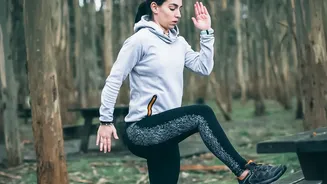
Proper form is nonstoppable for getting results and preventing injury. Stand facing your platform and place one entire foot firmly on top—your heel should not be hanging off the edge. Lean your chest slightly forward over your front foot to load the muscles. The magic of the stepup happens next: drive through the heel of your top foot to lift your body up until you are standing tall on the platform. The key is to make the front leg do all the work. Your back leg should remain passive; avoid the common mistake of pushing off the floor with it. At the top, stand up straight, squeezing your glutes. The descent is just as important. Lower yourself back down slowly and with control, which is known as the eccentric phase. Do not just fall or crash back down. Complete all repetitions on one leg before switching to the other for maximum muscle fatigue.
Common Mistakes to Avoid
Even a simple exercise can go wrong. The most frequent error is pushing off the back foot, which takes the load off the working leg and makes the exercise less effective. To fix this, try lifting the toes of your back foot off the ground slightly before you step up. Another common fault is choosing a box that is too high, which can lead to poor form and strain on your lower back. If you find yourself leaning excessively far forward or rounding your back, lower the step height. Finally, watch your knee alignment. Your knee on the working leg should always track over your middle toes and not collapse inward. If it does, it could be a sign of weak hip stabiliser muscles; lower the box and focus on slow, controlled movements.
Progressing Your Workout: Variations
Once you have mastered the basic bodyweight stepup, there are many ways to increase the challenge. The simplest progression is to add weight. You can hold dumbbells in each hand, a kettlebell at your chest, or even wear a weighted vest. Another option is to increase the height of your step, as long as you can maintain perfect form. For a different muscle focus, try lateral stepups, where you stand beside the platform and step up sideways. This variation increases the work on your inner and outer thighs. For a powerfocused, athletic challenge, you can perform explosive stepups, driving up as fast as possible, but this should only be done with excellent form and on a lower box.