

The Icy Enigma of Europa
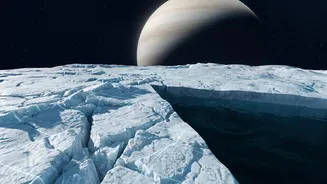
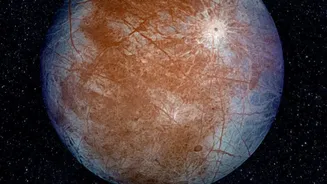
Europa is a world of incredible scientific interest primarily because of strong evidence suggesting a global ocean lies beneath its 15- to 25-kilometer-thick ice shell. This ocean is estimated to contain twice as much water as all of Earth's oceans combined.
Where there is liquid water, there is the potential for life, making Europa a prime target in our cosmic search for habitable environments. The challenge, however, is immense. The surface is a chaotic landscape of cracks and ridges, and it is blasted by intense radiation from Jupiter. Directly drilling through the ice is beyond our current technological reach. So, before we can ever hope to 'land' and sample this ocean, we first need to get a detailed picture of the ice shell itself—its thickness, its structure, and, most importantly, where it might be hiding pockets of liquid water closer to the surface.
Introducing Ice-Penetrating Radar
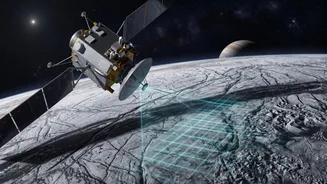
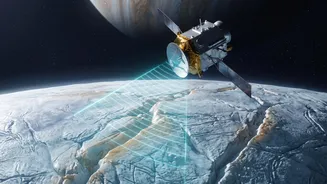
This is where a technology honed right here on Earth comes into play. For decades, scientists have used ice-penetrating radar to study the massive ice sheets of Antarctica and Greenland. The principle is ingeniously simple. Just as a ship’s sonar uses sound waves to map the seabed, this technology uses radio waves to see through ice. Lower-frequency radio waves can travel deep into clean ice with minimal loss of signal. When these waves encounter a boundary—such as the transition from ice to liquid water, or a layer of rock and dust embedded in the ice—they reflect back to the source. By measuring the time it takes for these echoes to return and their strength, engineers can create a 3D map of what lies beneath the surface, much like a geological ultrasound.
REASON: The Eyes of the Europa Clipper
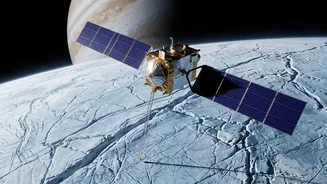
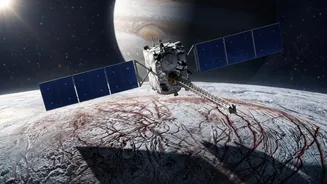
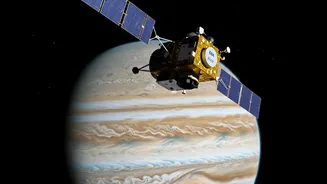
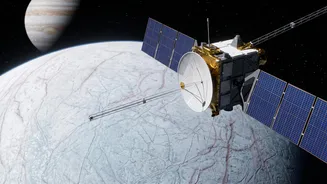
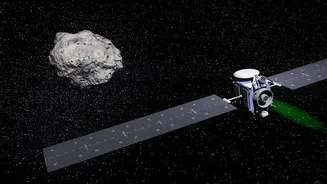
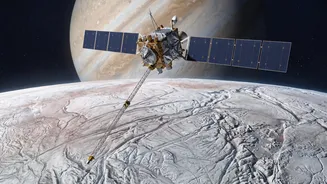
For its mission to Europa, NASA has equipped the Europa Clipper spacecraft with a highly advanced instrument called REASON, which stands for Radar for Europa Assessment and Sounding: Ocean to Near-surface. Launched in October 2024, the Clipper spacecraft is on a long journey to Jupiter, scheduled to arrive in April 2030. REASON is the only instrument on board that can look directly into the moon's icy shell. It operates using two different frequencies. A high-frequency (HF) signal at 9 MHz is designed for deep penetration, capable of sounding the full thickness of the ice down to the ocean itself, potentially as deep as 30 kilometers. A very-high-frequency (VHF) signal at 60 MHz provides higher-resolution views of the upper portion of the ice, allowing scientists to hunt for shallower features.
Searching for an Oasis Under the Ice
REASON's primary goal is to find the ice-ocean interface, which will give us the first definitive measurement of the ice shell’s thickness. But its objectives are far more nuanced than just finding the bottom. Scientists are particularly interested in finding perched lakes or pockets of liquid water trapped within the ice shell itself. These pockets are considered crucial for habitability. Chemicals and oxidants created on the surface by Jupiter’s radiation could be transported down into these water pockets through cracks and convective churning in the ice. These areas could create nutrient-rich environments, essentially acting as potential oases for life, separate from the deep ocean. REASON will map these internal structures, revealing if the ice shell is a static, impenetrable barrier or a dynamic system that allows for mixing between the surface and the water below.
Paving the Way for Future Missions
The data gathered by REASON will be revolutionary. Beyond charting the ice and searching for water, it will also measure the surface roughness and tidal flexing of the shell, providing clues about its mechanical properties. This information is not just for understanding Europa's geology; it is critical for planning future missions. By identifying areas where the ice is thinnest or where liquid water is closest to the surface, REASON will essentially create a treasure map for a potential future lander. It will pinpoint the most scientifically promising and safest locations to touch down, where we might one day be able to directly sample the material that has been in contact with Europa’s hidden ocean, bringing us one step closer to answering the profound question of whether we are alone in the universe.