




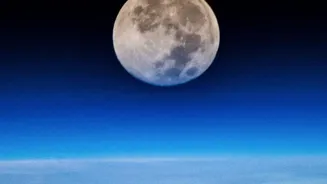


The Illusion We All Experience
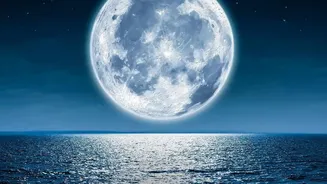
For thousands of years, philosophers and sky-gazers have been captivated by the 'Moon illusion'. It's the persistent feeling that the Moon is enormous when it’s near the horizon—peeking over buildings, trees, or mountains—but becomes a smaller, more distant
object when it’s high in the night sky. Many have speculated about the cause, with some early theories suggesting our atmosphere acts like a magnifying glass. However, the truth is both simpler and more complex: the Moon's size doesn't change at all. The entire spectacle is an elaborate optical illusion created entirely within our own minds.
The Unchanging Reality
If you were to take a photograph of the Moon when it's on the horizon and another hours later when it's overhead, using the same camera and zoom settings, you would find the Moon is the exact same size in both pictures. In fact, from a purely geometric standpoint, the Moon should appear about 1.5% smaller on the horizon. This is because when it’s overhead, you are one Earth-radius (about 6,400 kilometres) closer to it than when it is on the horizon. So, if anything, it should look slightly bigger at its zenith. Scientific instruments like theodolites can measure the Moon's angular size—the amount of space it takes up in our field of view—and confirm it remains a constant half-a-degree across the sky on any given night.
The View from Above
The headline's mention of space telescopes provides the ultimate, unbiased confirmation. Telescopes in orbit, like the Hubble or James Webb, observe the cosmos from outside Earth’s atmosphere. They are free from atmospheric distortion, clouds, and the terrestrial reference points that fool our brains. Their precise instruments can measure the angular size of celestial bodies with incredible accuracy. While astronomers have known the Moon's size doesn't change for centuries using ground-based tools and basic photography, space telescopes offer a pristine dataset that reinforces this fact. They see the Moon for what it is: a sphere of consistent size, whose apparent dimensions only change based on its elliptical orbit around Earth, not its position in our sky from night to night.
Your Brain’s Clever Deception
So, if the Moon isn’t changing, why do we see it that way? The leading explanation is a combination of psychological factors. The most prominent theory is known as the Ponzo illusion. This illusion demonstrates that when two identical objects are placed on converging parallel lines (like a railway track), the one that appears 'further' away is perceived by our brain as being physically larger. When the Moon is on the horizon, our brain uses cues like trees, buildings, and the landscape to judge distance. Because these objects are on the ground, our brain assumes the Moon is also very far away and 'inflates' its size in our perception to compensate. When the Moon is high up in the empty sky, there are no reference points, so our brain sees it without this size-correction effect.
The Apparent Distance Hypothesis
A related idea is the 'Apparent Distance Hypothesis'. Our brain perceives the sky not as a perfect hemisphere, but as a flattened dome, like an inverted bowl. We perceive clouds on the horizon as being much farther away than clouds directly overhead. We apply this same logic to the Moon. When it's on the distant-seeming horizon, our brain thinks it must be enormous to appear the size it does. When it is at the 'closer' zenith, our brain is content with its actual angular size. So, while some old theories blamed atmospheric refraction for magnifying the Moon, modern science shows refraction actually makes the horizon Moon look slightly squashed, not bigger. The reddish colour of a horizon Moon, however, is a real atmospheric effect caused by light scattering.