



The Constant Drag of Low Orbit
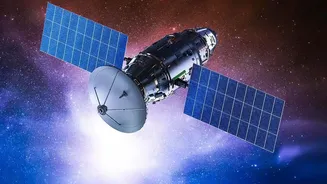
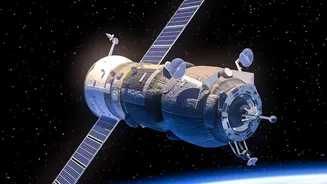
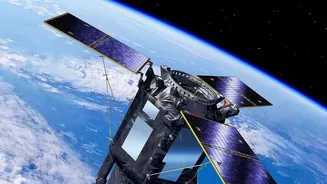
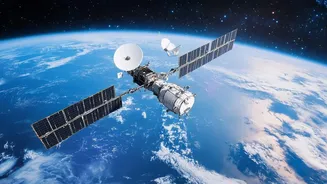
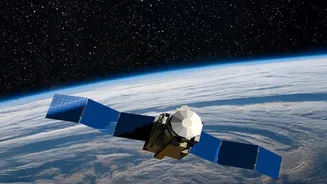
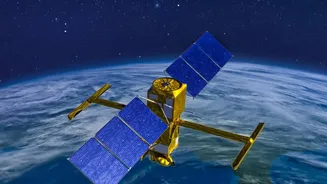
Imagine trying to run a marathon while wading through water. That’s the challenge for satellites in very low Earth orbit, typically classified as any altitude below 450 kilometres. While being closer to Earth offers huge advantages—like sharper images
for observation satellites and lower signal delay for communications—it comes at a cost. At these lower altitudes, the atmosphere, though incredibly thin, is still present. Molecules of air constantly collide with the satellite, creating a persistent drag that slows it down. To avoid falling out of orbit and burning up in the atmosphere, these satellites must constantly fire their thrusters to maintain altitude. This requires carrying a finite supply of propellant, like xenon gas. Once that fuel runs out, the satellite's mission is over. For years, this has been the fundamental trade-off: get closer for better data, but accept a much shorter operational life.
A Revolutionary Solution: The Air-Breathing Engine
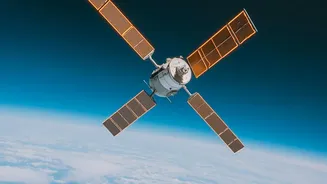
What if a satellite didn’t need to carry its own fuel? What if it could use the very atmosphere that creates drag as a propellant? This is the revolutionary concept behind air-breathing electric propulsion (ABEP). First successfully tested in a lab environment by the European Space Agency (ESA), this technology is designed to scoop up the sparse air molecules from the top of the atmosphere and use them to generate thrust. This effectively turns a satellite's biggest problem—atmospheric drag—into its greatest asset. By eliminating the need for on-board propellant, an ABEP-equipped satellite could theoretically operate almost indefinitely, limited only by the lifespan of its electronic components. This paves the way for a new class of long-duration missions that can remain in very low orbits for years on end.
How It Actually Works
The technology, while complex in its engineering, is elegant in its principle. It functions somewhat like a jet engine, but for the vacuum of space. As the satellite speeds through its orbit at roughly 7.8 kilometres per second, a specially designed intake passively collects the incoming air molecules. The main challenge has been to design a collector that traps these high-speed molecules instead of letting them bounce away. Once collected, the rarefied air is compressed and then ionized, meaning the molecules are given an electric charge, turning them into a plasma. An electric field then accelerates these charged particles and ejects them at high velocity, producing a continuous, low-level thrust that precisely counteracts atmospheric drag. The entire system is powered by solar panels, requiring nothing but electricity and the ambient atmosphere to function.
The Game-Changing Benefits
The implications of this technology are vast. The most obvious benefit is the potential for near-perpetual missions in VLEO. This unlocks the ability to provide persistent, high-resolution monitoring of our planet. For a country like India, this could mean enhanced capabilities for agricultural management, tracking climate change impacts like glacier melt, improving disaster response coordination, and bolstering national security with continuous surveillance. Furthermore, by flying lower, satellites can achieve better image resolution with smaller, less complex and therefore cheaper payloads. It also reduces signal latency for communication satellites, a growing market. And because these orbits are 'self-cleaning'—meaning any debris or defunct satellite will quickly de-orbit due to drag—it presents a more sustainable approach to space operations, helping to mitigate the growing problem of space junk.
What The Future Holds
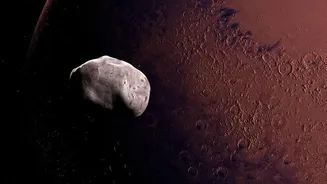
While the technology has been proven in ground-based simulations, the next step is a full-scale in-orbit demonstration. Researchers and private companies are actively working to overcome the remaining hurdles, such as optimizing the intake design for different atmospheric densities and ensuring materials can withstand the corrosive effects of atomic oxygen found in VLEO. The potential isn't limited to Earth. Such a system could one day be adapted for missions to other planets with atmospheres, like Mars, using the carbon dioxide atmosphere there as propellant. As development continues, air-breathing propulsion is poised to transition from a promising concept to an operational reality, fundamentally reshaping the economics and capabilities of Earth observation and satellite services.