




A Cosmic Shower Called 'Ring Rain'
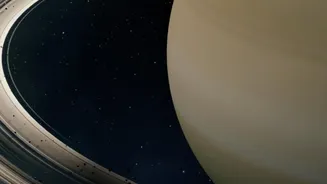
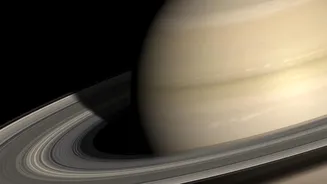
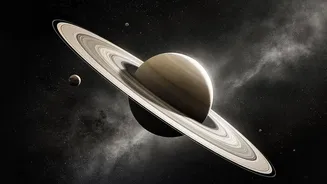
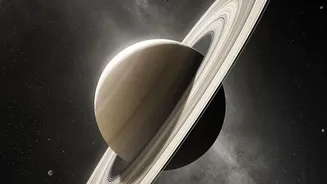
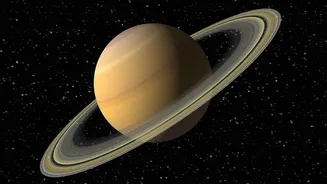
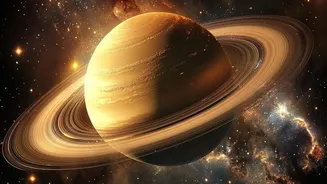
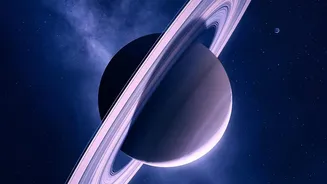
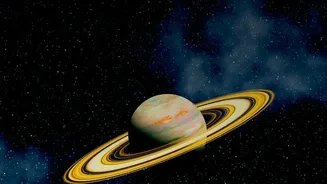
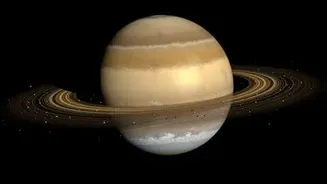
For decades, scientists viewed Saturn’s rings as a relatively stable, albeit fascinating, system of ice and rock particles orbiting the gas giant. However, a growing body of evidence confirms a much more active and dramatic relationship. The phenomenon,
dubbed 'ring rain', involves particles from the rings being pulled inward by the planet's immense gravity and powerful magnetic field. This isn't just a slow drift; it's a constant shower of material, primarily composed of water ice particles, raining down into Saturn's upper atmosphere. Early hints of this process came from Voyager spacecraft images in the 1980s, which showed dark bands on the planet that scientists theorised could be caused by this ring rain.
Confirming the Downpour with Cassini
The true scale of this interaction became clear thanks to NASA's Cassini spacecraft. During its 'Grand Finale' in 2017, Cassini made a series of daring dives into the previously unexplored gap between Saturn and its innermost rings. These final orbits allowed instruments to directly sample the material flowing from the rings to the planet. What they found was astonishing. The influx was far greater than previously estimated, with an amount of water equivalent to an Olympic-sized swimming pool draining from the rings every half an hour. This 'rain' is not just water; it also contains nanometer-sized dust grains, organic material, and other molecules, all pulled from the rings and deposited into Saturn's equatorial regions.
How Does It Happen?
Several forces conspire to make the rings 'rain' on Saturn. Micrometeoroid impacts and solar radiation can blast tiny particles off the main ring bodies, giving them an electrical charge. Once charged, these particles are susceptible to Saturn’s magnetic field, which acts like a conveyor belt, guiding them along invisible field lines down into the planet’s ionosphere. This process doesn't just add material to the planet; it actively changes its atmosphere. The influx of water-based particles 'quenches' parts of Saturn's ionosphere, reducing charged particle density and creating the darker, cooler bands observed decades ago. In a surprising twist, studies have also shown this icy rain is heating Saturn's upper atmosphere in a way never before seen in the solar system.
A Fleeting Celestial Wonder
The most profound implication of this discovery is that Saturn's rings are a temporary feature. They are not primordial, dating back to the formation of the solar system over four billion years ago. Instead, evidence suggests the rings are relatively young, perhaps only 10 to 100 million years old, possibly formed from a shattered moon or a comet that strayed too close. And just as they had a beginning, they will have an end. Based on the rate of material loss measured by Cassini and other observations, scientists estimate the entire ring system could disappear in as little as 100 million years, and will be gone within 300 million years. On a cosmic timescale, that is remarkably brief.