




The New Generation of Sky-Watchers
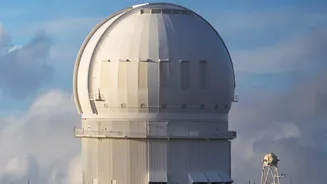
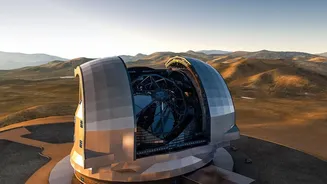
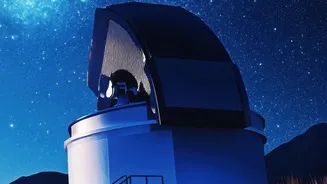
When we think of telescopes, we often picture astronomers peering through an eyepiece. But modern observatories are complex data-gathering machines. Facilities like the Vera C. Rubin Observatory in Chile are designed to systematically scan huge portions
of the sky with incredible speed and sensitivity. These aren't just for taking beautiful pictures of galaxies; they are robotic surveyors of the cosmos, equipped with massive mirrors and some of the largest digital cameras ever built. Their primary job is to notice change—to see what’s new, what's moving, and what flashes in the night. This capability makes them uniquely suited for two very different, but equally important, tasks: finding potentially hazardous asteroids and detecting the faint signatures of high-energy particles from space.
Catching a Cosmic Ghost
The term 'optical telescope' might seem ill-suited for detecting 'particles', but the method is ingenious. Cosmic rays are not light; they are high-energy particles, mostly protons, that originate from violent events like supernovae or black holes. We can't see the cosmic ray itself with a telescope. Instead, astronomers look for its footprint. When a high-energy cosmic ray slams into Earth’s upper atmosphere, it shatters atmospheric atoms, creating a cascade of secondary particles called an extensive air shower. These secondary particles are still moving so fast that they exceed the speed of light in air. This results in a faint, fleeting cone of blueish light known as Cherenkov radiation. Specialised optical instruments, known as Imaging Atmospheric Cherenkov Telescopes (IACTs), are designed to spot these nanosecond-long flashes against the dark sky. By using an array of these telescopes, scientists can reconstruct the direction and energy of the original cosmic ray, tracing it back to its cosmic source.
Messengers from a Violent Universe
Studying cosmic rays is crucial because they are direct samples of matter from outside our solar system. They provide a unique window into the most extreme environments in the universe, places far too distant to visit. The Cherenkov Telescope Array (CTAO) is a next-generation observatory being built for this purpose, with arrays in both the northern and southern hemispheres for full sky coverage. With unprecedented sensitivity, it will help answer fundamental questions about how particles are accelerated to such incredible energies, probe the environments around supermassive black holes, and even search for the signature of dark matter. By capturing the ghostly Cherenkov light, these optical telescopes help us understand the physics of exploding stars, active galaxies, and other high-energy phenomena that shape the cosmos.
Scanning for Near-Earth Neighbours
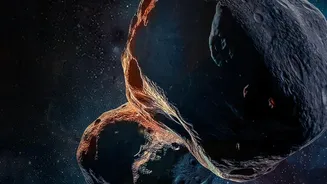
While Cherenkov telescopes look for the secondary effects of distant particles, other optical telescopes are focused much closer to home. Their mission: to map the solar system's population of near-Earth asteroids (NEAs). The principle is straightforward but requires immense precision. Wide-field survey telescopes, like the one at the Vera C. Rubin Observatory, repeatedly photograph large patches of the night sky. Powerful software then compares these images, taken minutes or hours apart. Stars and distant galaxies remain fixed, but an asteroid moving through our solar system will appear as a tiny dot of light that has shifted its position from one frame to the next. Once a moving object is flagged, more observations are made to precisely calculate its orbit.
Planetary Defence in Action
The ultimate goal of these asteroid surveys is planetary defence. While a civilization-ending impact from a massive asteroid is extremely rare, smaller objects a few hundred metres across can still cause significant regional devastation, and it's estimated we've only found about 40% of them so far. The Vera C. Rubin Observatory is expected to be a game-changer, discovering tens of thousands of new NEAs and dramatically improving our census of potentially hazardous objects. Even during its testing phases, Rubin has already discovered thousands of new asteroids, including some that are spinning faster than previously thought possible for their size, providing new clues about their composition. By identifying these space rocks and tracking their paths, these observatories act as an essential early-warning system, giving humanity the crucial time it might one day need to deflect a potential threat.