




The Cosmic Needle in a Haystack
Finding an exoplanet—a planet orbiting a star other than our Sun—is one of the most challenging tasks in modern science. Most are found using the 'transit method', where astronomers watch for a star's light to dim ever so slightly as a planet passes in front
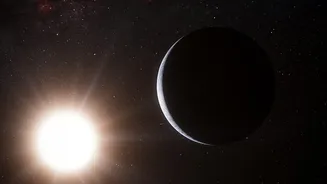
of it. We're talking about a dip in brightness that can be as small as one part in ten thousand, or the equivalent of spotting a fly crossing a car's headlamp from hundreds of kilometres away. A recent discovery of the exoplanet Beta Pictoris d, for example, was so faint it was almost missed. It's a signal so delicate that almost anything can mimic it or, worse, hide it completely. This is where the real, unglamorous work of planet hunting begins.
The Telescope's 'Pre-Flight' Checklist
A modern space telescope like the James Webb Space Telescope (JWST) or its predecessor, Kepler, is an incredibly complex machine. Before it can deliver breathtaking images, it undergoes a rigorous 'commissioning' phase. This is the space equivalent of a pilot’s pre-flight checklist, but it lasts for months and is vastly more complicated. Engineers on the ground test every system, calibrate every sensor, and understand every tiny quirk of the observatory. This is because, in the silence of space, the telescope isn't perfectly still or stable. It warms and cools, it vibrates, its electronic detectors have tiny imperfections, and it can be affected by cosmic rays. Each of these things creates 'noise' or 'systematic errors' in the data. If not accounted for, this noise can easily be mistaken for the dimming of a planet that isn't there, or it can drown out the signal of a planet that is.
From Earthly Glitches to Alien Worlds
So, what are these 'engineering checks'? They are sophisticated software routines and painstaking analysis designed to filter out the telescope's own behaviour from the starlight it observes. For example, as the telescope orbits Earth, its temperature might change by a fraction of a degree. This can cause its structure to expand or contract by mere microns, slightly altering how light hits the detector. This tiny shift can create a false dimming pattern. Astronomers write complex algorithms to model and subtract this thermal effect. Similarly, they create maps of 'hot pixels' or other detector flaws and correct the data from those specific spots. They even use the light from thousands of other stable stars in the same field of view to identify and remove noise patterns that affect the entire instrument. It’s a process of self-calibration, where the telescope essentially uses its own data to clean itself up.
The Unsung Heroes of Discovery
This process is rarely mentioned in the triumphant headlines of a new Earth-like planet. But without it, most discoveries would be impossible. The scientists who specialise in this are the unsung heroes of exoplanetology. They are not just astronomers; they are part data scientists, part engineers, and part detectives. They develop machine learning algorithms and sophisticated statistical tools to hunt for patterns of noise and remove them. The recently discovered Beta Pictoris d was only confirmed after two independent teams meticulously removed the star's glare and other instrumental noise to reveal the faint planet hiding within. It proves that the journey to another world often begins not with a grand gesture, but with the quiet, meticulous work of understanding the machine that's doing the looking.