
The 'Goldilocks' Blueprint
The search for life often begins with a simple concept known as the 'habitable zone', or more playfully, the 'Goldilocks zone'. This refers to the orbital region around a star where conditions are not too hot and not too cold, but just right for liquid
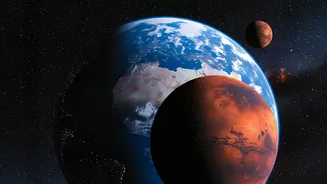
water to exist on a planet's surface. Earth sits comfortably within our sun's habitable zone, making it the primary model for this crucial requirement. Planets too close to their star, like Venus, have their water boiled away; those too far, like Mars, see it locked up as ice. Liquid water is considered essential because it is a universal solvent that allows the complex chemical reactions necessary for life as we know it to occur. Every search for extraterrestrial life, therefore, starts by looking for planets in this sweet spot, using Earth as the definitive example of a world that got the location just right.
An Atmosphere of Possibility
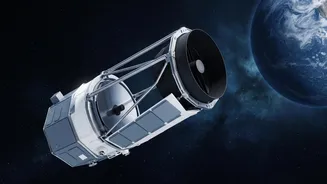
A planet's location is only part of the story. Earth's atmosphere is another key element that makes it a laboratory for habitability. This blanket of gas does more than just provide us with oxygen to breathe; it creates a stable greenhouse effect that keeps the planet's temperature from swinging to deadly extremes. Without it, Earth’s average temperature would be a frigid -18°C. This insulating layer also shields the surface from a significant amount of harmful solar radiation. When scientists use powerful instruments like the James Webb Space Telescope to analyse distant exoplanets, they are looking for atmospheres that share some of these protective and temperature-regulating qualities, using Earth's specific mix of nitrogen, oxygen, and trace greenhouse gases as a reference.
A Protective Magnetic Shield
One of the most underappreciated features of our habitable world is invisible: its magnetic field. Generated by the motion of molten iron in the planet’s core, this magnetic shield deflects the solar wind—a constant stream of charged particles flowing from the sun. Without this protection, the solar wind would gradually strip away our atmosphere, leaving the planet exposed and barren, a fate that likely befell Mars after its own magnetic field died. Therefore, when scientists assess an exoplanet's potential for life, they also consider its size and likely internal structure. A planet large enough to potentially retain a molten, active core is a much better candidate for long-term habitability because it has the means to generate a life-preserving magnetic field.
Searching for Life's Fingerprints
Earth doesn't just show us what a habitable planet looks like; it shows us what a planet with life on it looks like. Scientists hunt for 'biosignatures'—gases or other features in a planet's atmosphere that are likely produced by living organisms. On Earth, the most prominent biosignature is the high concentration of oxygen, a gas that is so reactive it would quickly disappear from the atmosphere if it weren't being constantly replenished by photosynthesis. The simultaneous presence of gases like methane and oxygen in our atmosphere is a chemical disequilibrium that strongly hints at biological activity. By studying Earth's atmospheric composition, scientists know what chemical imbalances to look for, turning their telescopes towards distant worlds in search of these telltale fingerprints of life.
A Planet's Past and Future
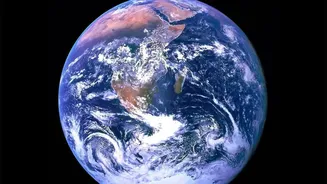
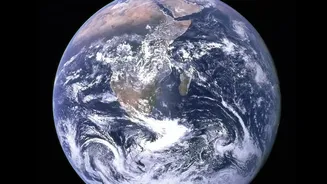
Our planet's 4.5-billion-year history provides a roadmap for how a world can evolve to support life. Earth wasn't always the blue marble it is today. Its early atmosphere lacked significant oxygen, and life existed for billions of years in a much different chemical environment. By studying Earth's geological past, scientists can model what a 'habitable' planet might look like at different stages of its development. This is crucial, as an exoplanet we discover today might be a 'young Earth', on the cusp of developing complex life, or an 'ancient Earth', where life has long since altered the atmosphere. This deep-time perspective allows researchers to widen their search and not just look for a perfect twin of modern Earth, but for a planet that could be on the same journey.