
Finding the Unseen Worlds
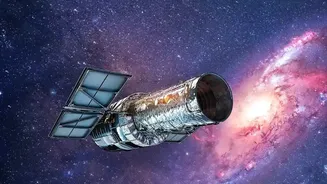
Before you can compare planets, you have to find them. Since exoplanets are too small and dim to see directly against the glare of their stars, astronomers become cosmic detectives. One primary method is the 'transit' technique, where telescopes like
NASA's TESS watch for tiny, periodic dips in a star's brightness. This dimming suggests a planet is passing in front of its star from our point of view. The amount of dimming reveals the planet's size, and the time between transits tells us its orbital period. Another powerful technique is the 'radial velocity' or 'wobble' method. A planet's gravity doesn't just keep it in orbit; the planet also tugs on its star, causing the star to wobble slightly. By measuring the subtle shift in the star's light as it moves toward and away from us—a phenomenon known as the Doppler effect—astronomers can detect this wobble and infer the presence and mass of an orbiting planet.
Taking a Planet's Temperature
A key factor for comparison is a planet's potential temperature. This is largely determined by its distance from its star. By combining the orbital period (from the transit method) and the star's properties, astronomers can calculate this distance. This allows them to determine if a planet falls within the 'habitable zone'—the orbital region where conditions might be just right for liquid water to exist on the surface. It's not too hot that water would boil away, nor so cold that it would be permanently frozen. While being in this zone doesn't guarantee habitability, it's a crucial first filter. Planets in this region, like some found in the TRAPPIST-1 system, become high-priority targets for further investigation.
Decoding an Alien Atmosphere
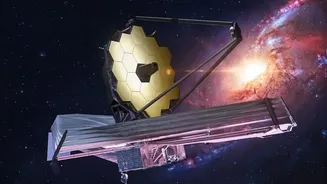
This is where the real deep dive begins. Using a technique called transmission spectroscopy, astronomers can actually read the chemical composition of an exoplanet's atmosphere. When a planet transits its star, a sliver of starlight passes through the planet's atmospheric fringe. Different gases in that atmosphere absorb specific wavelengths, or colors, of light. This leaves a unique chemical 'fingerprint' or 'barcode' in the starlight that reaches our telescopes. Powerhouses like the James Webb Space Telescope (JWST) are exquisitely sensitive to this effect. By analyzing which colors of light are missing, scientists can identify the molecules present, such as water vapor, methane, or carbon dioxide.
The Search for Hints of Life
The ultimate goal of atmospheric analysis is the search for biosignatures—gases or combinations of gases that could hint at the presence of life. On Earth, life produces a distinct atmospheric mix, including large amounts of oxygen and smaller amounts of methane. Finding a similar disequilibrium on another world, where certain gases exist at levels that geological processes alone can't easily explain, would be a monumental discovery. For example, the simultaneous detection of abundant methane and carbon dioxide could be a potential biosignature, as it suggests something is actively producing the methane. This is the core of how we compare worlds on the axis of habitability: not by seeing life, but by looking for its chemical echoes.
Why a 'Hint' Is Not Proof
Herein lies the great challenge. A potential biosignature is not definitive proof of life. Astronomers are incredibly cautious because non-biological, or 'abiotic', processes can sometimes mimic these signs. For instance, certain photochemical reactions in a planet's atmosphere or geological activity could produce oxygen or methane without any help from living organisms. This is why context is everything. Scientists must consider the type of star, the planet's geology, and other factors to rule out 'false positives'. The standard for proof is exceptionally high: it requires showing that a biological explanation is not just possible, but that all plausible abiotic explanations have been ruled out. Until then, astronomers can classify a planet as having a potentially habitable environment or an interesting atmosphere, but they cannot claim it has life.