







What Was CAPSTONE?
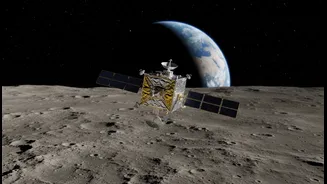
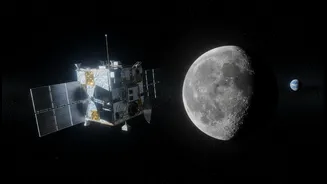
CAPSTONE, an acronym for Cislunar Autonomous Positioning System Technology Operations and Navigation Experiment, was a small spacecraft about the size of a microwave oven. Launched in June 2022, its primary job was not to host astronauts or conduct grand
science experiments, but to serve as a low-cost pathfinder. Owned and operated by the company Advanced Space for NASA, the mission was designed to test an ambitious new orbit around the Moon and demonstrate advanced navigation technologies that could one day form a kind of GPS for deep space. With a price tag under $30 million, it represented a new, more agile way of doing business in space, where learning from a small investment can prevent costly errors on a multi-billion dollar project down the line.
A Test Flight in a Strange New Orbit
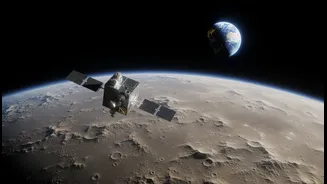
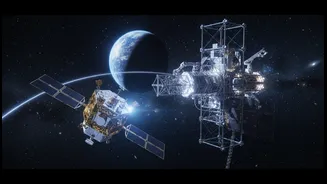
The core of CAPSTONE's mission was to fly in a Near-Rectilinear Halo Orbit (NRHO). This highly elliptical path had, until CAPSTONE, only existed in computer simulations. The orbit takes a spacecraft far out from the Moon—up to 70,000 kilometers—and then swoops in for a close pass of about 1,600 kilometers over one of the poles. This unique trajectory is incredibly stable, using a gravitational balance point between the Earth and Moon to minimize the amount of fuel needed for a long-term mission. This is the exact orbit planned for the Lunar Gateway, a future small space station intended to support NASA's Artemis missions. CAPSTONE’s job was to be the first to fly this route, verifying that the models were correct and that a station could safely operate there for years.
Embracing the Problems
A key part of any technology test is finding out what breaks. And CAPSTONE delivered. Shortly after launch, the mission team lost contact with the spacecraft for a time. Later, a stuck thruster valve sent the small craft into an uncontrolled spin, forcing engineers to work for over a month to regain control. It also experienced communication dropouts and challenges with its experimental navigation link-up with the Lunar Reconnaissance Orbiter (LRO). Far from being failures, these events were invaluable. They provided real-world data on how to recover a spacecraft in deep space, how to operate with malfunctioning hardware, and how resilient onboard systems need to be. Discovering these problems on a small, uncrewed CubeSat is infinitely better than discovering them for the first time on a crewed station.
Why a Test Isn't a Station
CAPSTONE’s journey perfectly illustrates the difference between a technology demonstration and an operational station. A test is designed to push limits, find failure points, and gather data. It is expected to have problems. A station, on the other hand, is infrastructure. It must be reliable, resilient, and, if crewed, incredibly safe. A station like the planned Gateway will require redundant systems, extensive life support, robust communications, and the ability to be serviced and maintained. Its job isn't to test an orbit, but to use that orbit as a reliable staging point for missions to the lunar surface. CAPSTONE was the scout checking the path; the Gateway is the outpost that will be built on the territory the scout surveyed. Conflating the two would be like mistaking a surveyor's tent for a skyscraper.
The Next Step: Building on the Lessons
Having successfully completed its primary and extended missions by mid-2026, CAPSTONE provided the crucial proof-of-concept NASA needed. It confirmed the stability of the NRHO, validated new autonomous navigation software, and gave mission controllers vital experience in this unique orbital environment. The lessons learned—from managing propulsion anomalies to understanding the radiation environment—directly inform the design and operational plans for the much larger and more complex Lunar Gateway. By sending a small, cost-effective probe first, NASA took a calculated risk that paid off, saving potentially billions of dollars and dramatically reducing the risks for future astronauts. It's a model of how to explore responsibly, proving that sometimes the most important step is the small one that comes before the giant leap.