


Hours spent hunched over a desk can lead to rounded shoulders and a sore back. Counteract the effects of a sedentary job with targeted exercises that strengthen key postural muscles, helping you stand taller and feel better.
Bent-Over Dumbbell Row
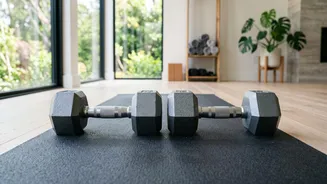
This exercise is a powerhouse
for building a stronger back. It targets the large latissimus dorsi muscles as well as the rhomboids and traps, which are responsible for pulling your shoulder blades together. Strengthening these muscles directly combats the forward slouch that often develops from sitting at a computer. To perform it, hold a dumbbell in each hand with a neutral grip (palms facing each each other). Hinge forward at your hips until your torso is nearly parallel to the floor, keeping your back straight. Pull the dumbbells toward your lower ribs, squeezing your shoulder blades at the top of the movement. Lower the weights slowly and with control.
Face Pull
The face pull is one of the best exercises for shoulder health and correcting poor posture. It specifically targets the often-neglected rear deltoids and upper-back muscles like the rhomboids and rotator cuff. These are the exact muscles that become weak and stretched from prolonged hunching. To do it, set a cable machine pulley to chest or eye level with a rope attachment. Grasp the rope with both hands and step back to create tension. Pull the rope toward your face, allowing your elbows to flare out and high. As you pull, think about pulling the handles apart and squeezing your shoulder blades together. This movement helps restore balance to the shoulder girdle.
Plank
While it may seem simple, the plank is a foundational exercise for spinal health. A strong core is essential for providing a stable base for your spine, reducing the strain on your lower back. Holding a plank engages the deep core muscles that act as a natural corset for your torso. To get into position, rest on your forearms and toes, keeping your body in a straight line from your head to your heels. Engage your abdominal muscles to prevent your hips from sagging or rising too high. Hold this position, focusing on maintaining a neutral spine without arching your back.
Bird-Dog
The bird dog is a safe and highly effective exercise for enhancing core stability and training your body to keep the spine in a neutral position while your limbs are moving. This is crucial for preventing lower back pain. Start on all fours with your hands directly under your shoulders and your knees under your hips. Engage your core, and simultaneously extend your right arm straight forward and your left leg straight back. Keep your hips and shoulders level, avoiding any rotation in your torso. Hold for a moment before returning to the start and repeating on the other side.
Scapular Wall Slides
This movement specifically targets the muscles that control your shoulder blades (scapulae), which is vital for good posture. Desk work can cause these muscles to become underactive, letting your shoulders round forward. To perform a wall slide, stand with your back flat against a wall. Place your arms against the wall in a 'goalpost' position, with your elbows bent at 90 degrees. Slowly slide your arms up the wall, keeping your elbows, wrists, and the back of your hands in contact with the wall at all times. Go as high as you can without losing contact, then slowly slide back down.
Cat-Cow Stretch
Though more of a mobility drill than a strengthening exercise, the cat cow is invaluable for desk workers. It increases flexibility and relieves tension throughout the entire spine, which can become stiff from sitting in one position for too long. Start on your hands and knees. On an inhale, drop your belly, lift your chest, and look up, arching your back (Cow Pose). On an exhale, round your spine toward the ceiling, tucking your chin to your chest (Cat Pose). Moving between these two positions helps to gently mobilize the vertebrae and reduce stiffness.