






The Universe’s Most Extreme Objects
Before we get to the spin, let’s talk about what a neutron star actually is. When a massive star—much bigger than our sun—runs out of fuel, it collapses under its own immense gravity and then explodes in a supernova. While the outer layers are blasted
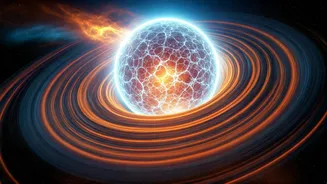
into space, the star's core implodes into an object of almost unimaginable density. Protons and electrons are crushed together to form neutrons, hence the name. The result is a sphere roughly the size of a U.S. city, like Manhattan or Chicago, but containing more mass than our entire sun. A single teaspoon of neutron star material would weigh about as much as Mount Everest, or several billion tons. They are, without exaggeration, the densest objects in the universe that we can directly observe, second only to the theoretical singularity inside a black hole.
The Cosmic Ice Skater Effect
So why the incredible spin? It all comes down to a principle you’ve seen at the Winter Olympics: the conservation of angular momentum. Think of an ice skater spinning with her arms outstretched. As she pulls her arms in, her spin gets dramatically faster. The star that created the neutron star was already spinning, albeit much more slowly. But as that massive star collapsed from a diameter of millions of miles down to just a dozen, its spin rate skyrocketed in the same way. All that original rotational energy is now concentrated into a tiny, dense ball. This cosmic ice skater effect is what sends these stellar corpses into a frenzy, whipping them around hundreds of times every single second. The fastest one ever recorded, PSR J1748-2446ad, spins at a blistering 716 times per second—so fast that its equator is moving at nearly a quarter of the speed of light.
A Lighthouse in Deep Space
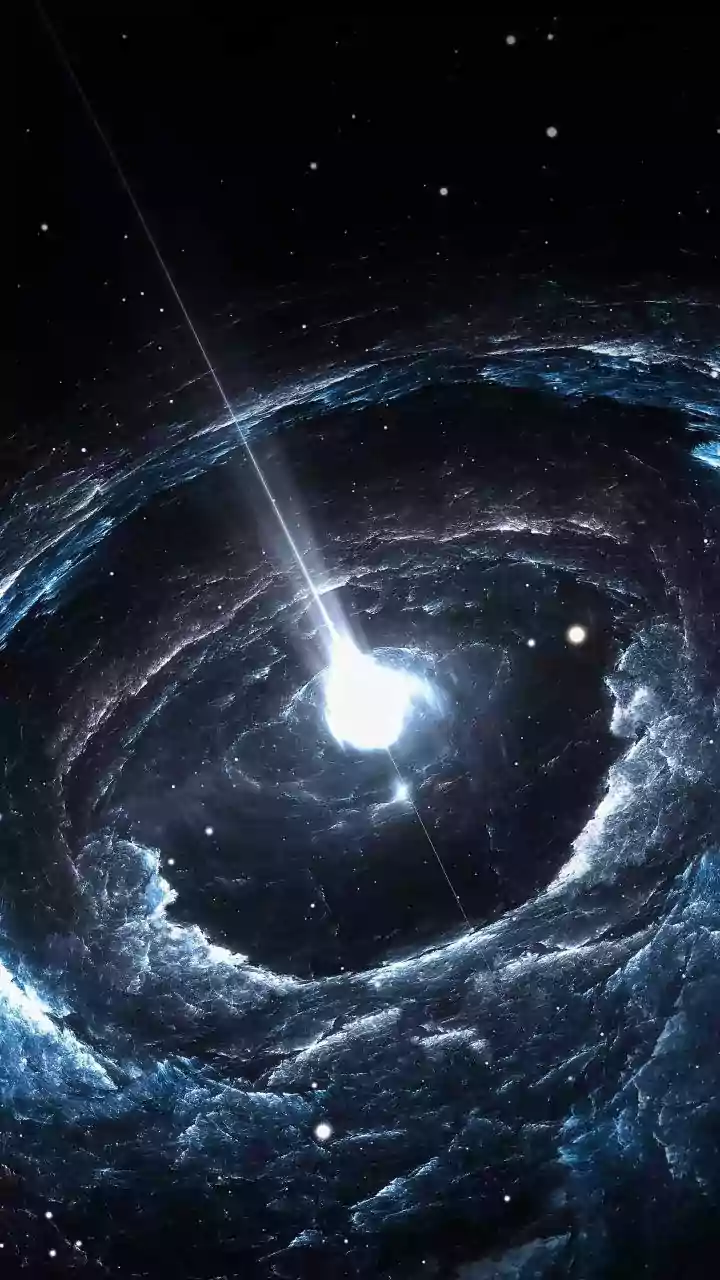
Even with this frantic spinning, we don't exactly 'see' a neutron star in a conventional telescope. They are far too small and distant. Instead, we detect their effects. Neutron stars have incredibly powerful magnetic fields, which funnel jets of radiation—like radio waves or X-rays—out from their magnetic poles. As the star spins, these beams sweep through space like the beacon of a lighthouse. If Earth happens to be in the path of one of these beams, our telescopes register a 'pulse' of energy each time it sweeps past us. This is why spinning neutron stars are often called 'pulsars.' The time between these pulses tells us precisely how fast the star is rotating. A star spinning 600 times a second will send us 600 pulses of radiation every second, a cosmic metronome of unbelievable speed.
The High-Tech Ghost Hunters
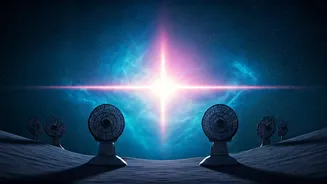
Detecting these faint, rapid-fire pulses from across the galaxy requires extraordinary technology. On the ground, massive radio telescopes like the now-decommissioned Arecibo Observatory or the Very Large Array (VLA) in New Mexico have been the workhorses of pulsar astronomy for decades, capable of capturing the faint radio signals. But the most exciting new developments are happening in space. NASA’s Neutron star Interior Composition Explorer (NICER), an instrument mounted on the International Space Station, is specifically designed to detect X-ray pulses from these objects. By timing the arrival of these X-ray photons with incredible precision, NICER not only measures a neutron star's spin but can also help scientists figure out its size and internal structure, testing the limits of physics under conditions impossible to replicate on Earth.