



The Junkyard Above Our Heads
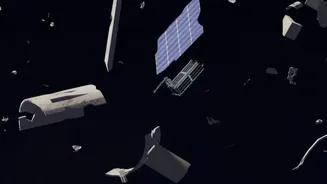
Since the launch of Sputnik 1 in 1957, humanity has been populating the space around Earth not just with active satellites, but with a growing cloud of garbage. This orbital debris consists of everything from defunct satellites and spent rocket stages
to tiny flecks of paint and frozen liquids. There are an estimated 130 million objects larger than a millimeter orbiting our planet, with tens of thousands large enough to be tracked from the ground. Traveling at speeds up to 28,000 km/h in Low Earth Orbit (LEO), even a tiny fragment can strike an operational satellite with the force of a bullet, causing catastrophic damage. This high-speed threat endangers the critical infrastructure we rely on for GPS, weather forecasting, telecommunications, and even national security.
The Magnetic 'Net' Solution
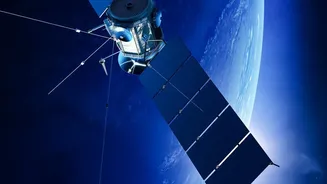
The term 'magnetic net' covers a range of innovative technologies designed for active debris removal. One leading approach involves a 'chaser' spacecraft that uses magnetic forces to grapple a piece of debris. Japanese company Astroscale has been a pioneer with its ELSA-d mission, which successfully demonstrated a magnetic docking plate system. The idea is that future satellites will be built with these simple plates, making them easy for a 'servicer' satellite to magnetically latch onto and pull out of orbit at the end of their life. Another fascinating concept uses spinning magnets on a robotic arm to create eddy currents in non-magnetic but conductive debris, like objects made of aluminum. This essentially turns the junk into a temporary electromagnet, allowing it to be manipulated and moved without physical contact.
The Race to Clean Up Space
Several organizations are pushing these technologies from theory into practice. Besides Astroscale, the European Space Agency (ESA) is heavily invested in active debris removal. Its ClearSpace-1 mission, planned for the latter half of 2026, will be a major demonstration, aiming to capture and deorbit a piece of a defunct satellite. While ClearSpace initially planned to use robotic arms, the growing interest in magnetic systems highlights a diversified approach across the industry. In India, the push for a sustainable space environment is also gaining momentum. The Indian government's 'Debris Free Space Mission' aims for all Indian space activities to be debris-free by 2030, and ISRO's NETRA program is enhancing its ability to track these orbital threats. Recently, Samtel Avionics and Japan's BULL Co. signed an agreement to explore combining active removal systems with passive de-orbiting technology, signaling a more integrated, global approach to the problem.
More Than Just a Technical Problem
Capturing a tumbling, uncooperative object weighing several tonnes as it speeds through space is an immense technical challenge. But the hurdles aren't just technical. There are significant legal and financial questions. Who is responsible for old debris? Who pays for the cleanup? The space junk problem is what economists call a negative externality—the cost of launching satellites is borne by operators, but the risk created by the resulting debris is shared by everyone. This has led to the dreaded 'Kessler Syndrome' scenario, a theoretical cascade where collisions create more debris, which in turn causes more collisions, potentially rendering parts of LEO unusable for generations. Preventing this requires not only cleanup technology but also international cooperation and clear regulations for satellite end-of-life procedures.
Protecting Our Satellite-Dependent World
Cleaning up LEO is not an abstract scientific exercise; it's about protecting modern life. In India and across the globe, we depend on a seamless network of satellites for daily activities. A collision in orbit doesn't just mean one lost satellite; it can disrupt communication networks, affect financial transactions, compromise weather warnings for cyclones, and impact the navigation services we use every day. Active debris removal, whether by magnetic systems, robotic arms, or harpoons, is an essential investment in the long-term sustainability of the space economy. By developing and deploying these cosmic sanitation services, the global space community is working to ensure that the final frontier remains open, safe, and useful for the future.