





The Big Question: Is ₹30,000 Realistic?
Let's address the elephant in the room: ₹30,000 for a trip to Vietnam is an extremely tight budget, and whether it's possible depends heavily on one major exclusion: flights. Return flights from India to Vietnam can cost anywhere from ₹18,000 to ₹30,000 or more,
depending on your departure city and how far in advance you book. Therefore, this guide assumes the ₹30,000 budget is for your expenses within Vietnam for a trip of around 10 to 12 days. This is challenging but achievable if you travel like a true backpacker, prioritizing local experiences over comfort. At a current exchange rate of roughly 1 INR to 270-275 VND, your ₹30,000 becomes approximately 8.2 million Vietnamese Dong. It’s a lot of zeroes, but it requires careful planning.
Your Pre-Trip Essentials: Visa
Before you even think about packing, you need a visa. Indian passport holders are required to have a visa to enter Vietnam. The most straightforward and recommended method is applying for an e-visa through the official government portal. A single-entry e-visa, valid for up to 90 days, typically costs around $25 USD. This translates to approximately ₹2,100 to ₹2,500. It's crucial to apply through the official site to avoid inflated agent fees. The process takes a few business days, so get this sorted at least two weeks before your trip.
Budget Breakdown: Daily Spending
Here’s how your ₹30,000 might break down over a 10-day trip after your visa cost, leaving you with roughly ₹27,500 (or about 7.5 million VND).
Accommodation (₹7,000 / ~1.9 million VND): Vietnam’s hostel network is your best friend. A dorm bed in major cities like Hanoi or Ho Chi Minh City can cost as little as ₹400-₹700 (120,000-180,000 VND) per night. Booking a 10-night stay will fit comfortably within this budget.
Food (₹8,000 / ~2.2 million VND): This is where Vietnam shines for budget travellers. You can eat incredibly well for very little. A filling bowl of pho or a delicious banh mi sandwich often costs between 30,000 and 60,000 VND (₹110-₹220). If you stick primarily to street food, a daily budget of ₹800 (around 220,000 VND) is more than enough for three satisfying meals.
Transport (₹7,500 / ~2 million VND): To cover the length of the country, sleeper buses are the most cost-effective option. An overnight journey from Hanoi in the north to central Vietnam (like Hue or Da Nang) can cost between 470,000 and 820,000 VND (₹1,700-₹3,000). Budgeting for two or three such long journeys, plus local city buses or ride-hailing apps for short distances, will fit within this allocation.
Activities & Buffer (₹5,000 / ~1.4 million VND): This portion covers entrance fees for attractions, perhaps a boat trip in Ninh Binh, and a buffer for unexpected costs. Many sights, like wandering through Hanoi's Old Quarter or lounging on a beach in Da Nang, are free.
Sample 10-Day Itinerary: North to South
This classic route allows you to see the country’s diverse landscapes efficiently.
Days 1-3: Hanoi & Ha Long Bay (On a Budget)
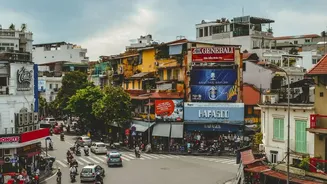
Arrive in Hanoi. Spend two days exploring the Old Quarter, Hoan Kiem Lake, and soaking in the capital's chaotic charm. Instead of an expensive overnight cruise on Ha Long Bay, consider a more affordable day trip from Hanoi or a trip to the equally stunning, but often cheaper, Ninh Binh province, known as 'Ha Long Bay on land'.
Days 4-6: Central Vietnam (Hue & Hoi An)
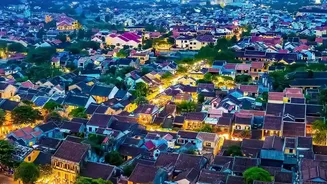
Take an overnight sleeper bus from Hanoi to Hue. Spend a day exploring the Imperial City and royal tombs. Then, take a short bus ride to Hoi An. Spend two days enchanted by the lantern-lit ancient town. To save money, rent a bicycle to explore the surrounding countryside and beaches instead of taking taxis.
Days 7-9: Ho Chi Minh City & Mekong Delta
Take another overnight bus from the Da Nang/Hoi An area to Ho Chi Minh City (HCMC). Dive into the bustling energy of HCMC, visiting the War Remnants Museum and Ben Thanh Market. Take a budget-friendly day tour to the Mekong Delta to see the river life.
Day 10: Departure from HCMC
Enjoy a final Vietnamese coffee before heading to the airport.
Essential Money-Saving Tips
To make your Dong go further, embrace the local lifestyle. Eat where the locals eat; the food is better and cheaper. Use sleeper buses for long distances to save on a night's accommodation. Learn a few words of Vietnamese – it goes a long way. Bargain politely at markets, as initial prices are often inflated for tourists. Finally, walk as much as you can. Cities like Hanoi and Hoi An are incredibly walkable and exploring on foot is the best way to find hidden gems you’d otherwise miss.