



Why Everything Ends in the Ocean
When you're sending humans to space, their safety is the absolute, non-negotiable priority. For the Gaganyaan mission, this means planning for every possibility, including a mission abort during launch or a normal return after orbiting Earth. In nearly
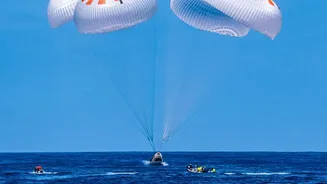
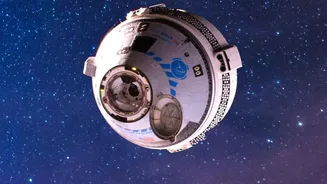
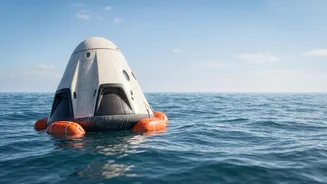
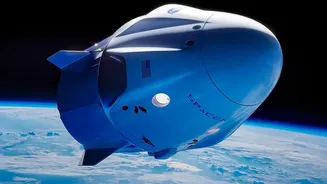
all scenarios, the journey for the crew module ends with a splashdown in the ocean. This is by design. A sea landing provides a vast, flat, and unpopulated area to target, significantly reducing risks compared to a land-based return. However, it introduces its own set of complex challenges. The capsule must not only survive the fiery re-entry through the atmosphere but also handle a splashdown and remain a safe, stable haven for the astronauts until recovery teams arrive.
Simulating the Unthinkable: Abort Scenarios
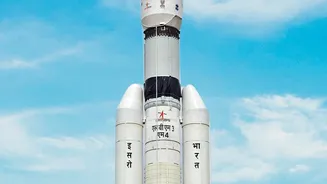
Before astronauts ever set foot in the Gaganyaan capsule, ISRO must prove it can handle the worst-case scenarios. This is where abort tests come in. In October 2023, ISRO conducted the crucial Test Vehicle Abort Mission-1 (TV-D1). This test wasn't about going to orbit; its sole purpose was to simulate a launch failure. A specially designed test rocket carried a replica of the crew module to an altitude of about 17 kilometres. Then, an abort was deliberately triggered, firing the Crew Escape System (CES) — a set of powerful, quick-acting motors that pull the crew module away from the failing rocket at high speed, much like an ejection seat for the entire capsule. The test successfully demonstrated that the module could be safely jettisoned, stabilise itself, deploy parachutes, and splash down in the Bay of Bengal.
The Flotation Test: A Life Jacket for the Capsule
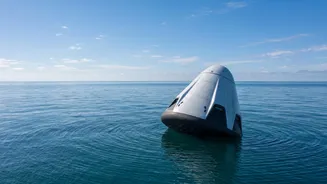
Surviving the splashdown is only half the battle. A capsule can easily land upside down or at an awkward angle in the water, a situation NASA called "Stable 2" during the Apollo era. This can be disorienting and dangerous for the crew inside. To solve this, ISRO has developed the Crew Module Uprighting System (CMUS). Think of it as an automatic life jacket for the spacecraft. In a series of recent tests in July 2026, ISRO validated this system. It uses compressed gas stored in high-pressure bottles to inflate flotation bags. These bags automatically deploy to turn the capsule upright, ensuring it remains stable in the ocean while awaiting recovery. The tests confirmed the system could inflate reliably and quickly, a critical feature for crew safety.
Cutting the Cord: Umbilical and Cover Separation
Several other critical separation events must happen perfectly for a safe return. ISRO has also recently tested the system that disconnects the 'umbilical' cords between the crew module and the service module. These connections supply power and life support during the mission, but they must be severed cleanly before re-entry. Any failure here could be catastrophic. Another test validated the jettisoning of the apex cover. This cover protects the parachutes during launch and orbit. To ensure a soft landing, this cover must be blown away at a precise altitude to allow the drogue and main parachutes to deploy in sequence. The successful qualification of these pyrotechnic and mechanical systems proves the capsule can perform these crucial steps reliably.
The Final Step: Recovery from the Sea
A successful splashdown is meaningless if the crew can't be brought back to shore. The final piece of the puzzle is recovery. For every sea-based test, including the TV-D1 mission, the Indian Navy is an integral partner. Its ships, divers, and helicopters are pre-positioned to race to the splashdown zone, locate the floating capsule, and retrieve it. These trials are as much a test for the Navy's recovery procedures as they are for ISRO's hardware. Every test hones the coordination required to safely extract the crew module and, eventually, its human occupants from the ocean, closing the final loop on a successful mission.