



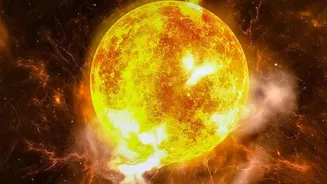
The Sun’s Unpredictable Fury
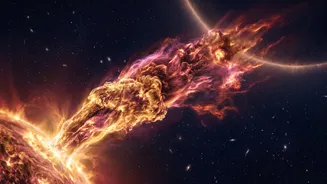
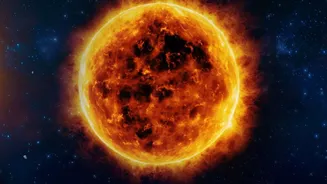
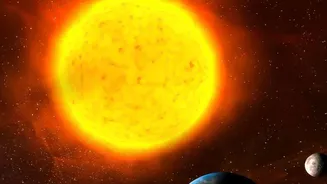
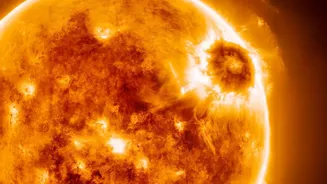
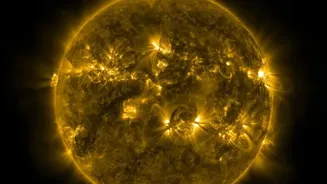
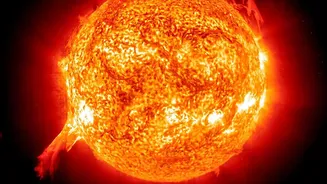
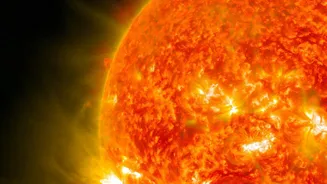
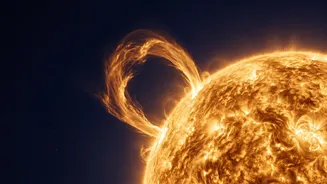
The Sun, our life-giving star, has a tempestuous side. It frequently blasts enormous clouds of charged particles and energy into space. These events, known as coronal mass ejections (CMEs) or solar flares, can create what is called space weather. When
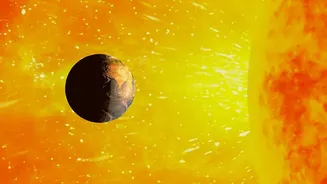
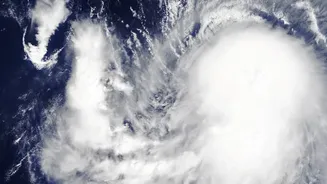
a powerful solar storm heads towards Earth, it interacts with our planet's magnetic field, triggering geomagnetic storms. While these storms are responsible for the beautiful auroras at the poles, they also pose a significant threat to our modern, tech-dependent society. A severe event could induce currents that overload power grids, leading to widespread blackouts. It can also disrupt radio communications, damage satellite electronics, and degrade GPS signals, affecting everything from aviation and shipping to everyday navigation.
Racing Against a Solar Clock
The challenge for scientists has always been speed and accuracy. The particles from a solar storm travel at incredible speeds, leaving a very short window between detection and impact. For decades, predicting exactly where and when a geomagnetic disturbance would strike has been a monumental task. Previous models often struggled, either providing localized forecasts that missed the global picture or offering global predictions that weren't timely enough to be actionable. With the Sun's activity expected to peak in its 11-year cycle around 2025, the risk of a major event is increasing, making the need for a better warning system more urgent than ever.
Enter DAGGER: The AI Forecaster
In response to this challenge, an international team of researchers, in a public-private partnership including NASA, has developed an innovative solution: DAGGER, which stands for Deep Learning Geomagnetic Perturbation. This new AI-powered computer model is designed to provide rapid and accurate global predictions of where a solar storm's effects will be felt on Earth, offering a crucial 30-minute advance warning. This is a significant leap forward, likened to having a tornado siren for space weather. The system was developed at the Frontier Development Lab, a partnership that includes NASA, the U.S. Geological Survey, and the Department of Energy.
How AI Outsmarts a Storm
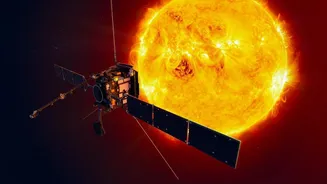
DAGGER’s power comes from a method called “deep learning.” The AI was trained on vast amounts of data, identifying complex patterns and relationships between measurements of the solar wind (the stream of particles from the Sun) and the resulting geomagnetic disturbances recorded at ground stations across the planet. By analysing data from several heliophysics missions, the AI learned how specific changes in the solar wind lead to impacts on Earth. Unlike its predecessors, DAGGER combines the swift analysis of AI with real-time measurements to generate a global forecast in less than a second, with updates every single minute. This allows it to predict the location and intensity of a storm's impact with unprecedented speed and precision.
A Shield for a Connected Planet
A 30-minute warning might not sound like much, but for critical infrastructure operators, it’s a game-changer. Power grid operators could have time to reroute power and take systems offline to prevent catastrophic overloads and blackouts. Satellite controllers could put their spacecraft into a protective safe mode, safeguarding sensitive electronics from damaging radiation. Telecommunications and aviation sectors could prepare for potential signal disruptions. Vishal Upendran of India's Inter-University Centre for Astronomy and Astrophysics, the lead author of the paper on DAGGER, noted that this AI makes it possible to inform decisions that could minimize or even prevent devastation. The model's code has been made open-source, allowing companies and agencies around the world to adapt it for their specific needs, strengthening our global defences against the Sun’s fury.