




The Blurry Line Between Rock and Ice
For a long time, the distinction seemed simple: asteroids are inert rocks, and comets are 'dirty snowballs' of ice and dust that sprout brilliant tails as they near the sun. But the universe is rarely that neat. Astronomers are increasingly finding objects
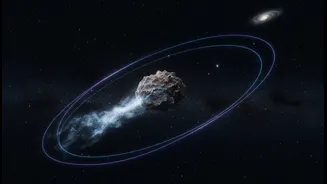
that defy these easy labels. A prime example are 'Centaurs', a class of objects orbiting between Jupiter and Neptune that exhibit traits of both asteroids and comets. Several, like the object Chiron, were first classified as asteroids only to later develop a cometary coma—a fuzzy cloud of gas and dust. These discoveries force a fundamental question: are we looking at two distinct types of objects, or a single population in different life stages? An inactive object today could be a dormant comet, merely waiting for a slight nudge in its orbit to bring it closer to the sun and awaken its frozen volatiles.
Meet the 'Dark Comets'
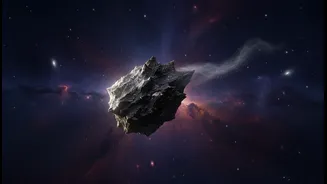
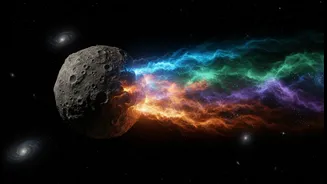
The latest twist in this cosmic identity crisis is the concept of 'dark comets'. These are objects that look like asteroids—they don’t have a visible tail or coma—but move in ways that can't be explained by gravity alone. This subtle, non-gravitational acceleration is a classic sign of cometary activity, caused by jets of sublimating gas pushing the object like a tiny, invisible rocket engine. The phenomenon suggests that these objects are outgassing, but so weakly that our telescopes can't see the resulting dust cloud. They are comets in disguise. First theorised after observing the interstellar visitor 'Oumuamua in 2017, scientists have since identified more than a dozen of these enigmatic bodies in our own solar system, forcing a new layer of complexity into how we map our celestial neighbourhood.
Why Classification Matters for Planetary Defense
This isn't just an academic debate about naming conventions; it has real-world consequences for planetary defense. Our ability to protect Earth from a potential impact hinges on accurately predicting an object's future path. An asteroid’s orbit is governed purely by gravity and is therefore highly predictable. A comet's orbit, however, is influenced by the unpredictable thrust from outgassing. If an object we’ve labelled as a harmless asteroid is actually a dormant or dark comet, its trajectory could change unexpectedly as it warms up. This introduces a dangerous element of uncertainty. Misclassifying an object means we might miscalculate its future position, potentially turning a predicted near-miss into a direct threat. Accurately identifying these camouflaged comets is crucial for creating reliable long-term risk assessments.
A New Framework for the Solar System
These discoveries are pushing astronomers to rethink the rigid classification systems of the past. Historically, objects were sorted based on their orbit and appearance. Now, it's becoming clear that a more fluid approach is needed, one that acknowledges the dynamic nature of these small bodies. An object can transition from a Kuiper Belt object to a Centaur, then into a Jupiter-family comet. It can appear as an asteroid for millennia, only to reactivate. As a result, scientific bodies are developing new taxonomies that account for an object's physical composition and potential for activity, not just its current state. Projects like China's planned early-warning system and global planetary defense drills highlight the growing international consensus that we need better tools to monitor all near-Earth objects, regardless of what we call them.