








Meet Your New Cosmic Neighbour
Astronomers have confirmed the presence of a 'super-Earth' orbiting a star just 25 light-years away in the constellation Camelopardalis. Named GJ 3378 b, this exoplanet is not a new discovery, having first been detected in 2024. However, a recent and
more detailed analysis of its properties has catapulted it to the top of the 'most interesting' list for scientists searching for life beyond our solar system. On a galactic scale, this planet is exceptionally close. For perspective, our Milky Way galaxy is about 100,000 light-years across. As one research-team leader noted, while 25 light-years sounds far, this planet is effectively in our immediate celestial neighbourhood.
A Super-Earth Done Right
What makes GJ 3378 b so exciting are its revised vital statistics. Initial estimates suggested the planet was over five times the mass of Earth. But a new study, using data from powerful instruments like the Habitable-zone Planet Finder, has revised its mass down to a much smaller 2.3 times that of Earth. This is a critical distinction. Planets above a certain mass tend to accumulate thick, crushing gas atmospheres, becoming more like mini-Neptunes than rocky worlds. At its new, lighter weight, GJ 3378 b is almost certainly a terrestrial, rocky planet, dramatically increasing the chances it could have a solid surface and a more Earth-like atmosphere.
Location, Location, Habitation?
GJ 3378 b orbits its parent star squarely within the 'habitable zone'—the orbital range where temperatures could allow liquid water to exist on a planet's surface. In fact, it receives about 90% of the energy that Earth gets from the sun, placing it in a temperate sweet spot. However, there is a significant catch. Its host star is a red dwarf, the most common type of star in our galaxy. While long-lived, these stars can be notoriously volatile, especially in their youth, blasting nearby planets with intense radiation that can strip away their atmospheres over billions of years. The ultimate question of habitability for GJ 3378 b now hinges on whether it managed to hold onto its atmosphere. If it did, it's a world of immense possibility. If not, it becomes a crucial case study in how planets die.
A Target for Tomorrow's Telescopes
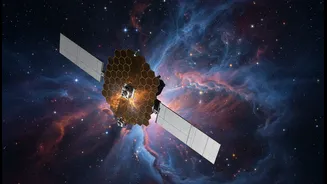
The true significance of GJ 3378 b lies in its role as a 'realistic future target'. For decades, astronomers have been finding thousands of exoplanets, but most are too far away to study in any detail. A nearby world changes the game entirely. Proximity makes it possible for the next generation of incredibly powerful observatories to do more than just detect a planet's existence. Because GJ 3378 b is so close, future instruments like the Giant Magellan Telescope, the Extremely Large Telescope, and NASA's planned Habitable Worlds Observatory may be able to directly analyse its atmosphere. These observatories are being designed specifically to hunt for biosignatures—chemical fingerprints like oxygen or methane that could indicate the presence of life. GJ 3378 b gives them a perfect, high-priority address to investigate.