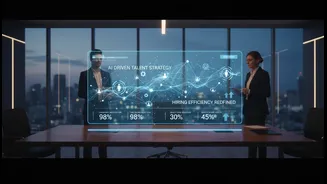









Beyond Basic Resume Screening
For years, the promise of AI in recruitment was simple automation: scanning thousands of resumes for keywords. But the story in India has evolved. Today, “sharper AI-ready hiring” refers to a more intelligent suite of tools that are fundamentally altering
talent acquisition. We're now seeing the deployment of AI that analyzes skills beyond keywords, predicts a candidate's potential for success, and even assesses soft skills through video and game-based assessments. These systems use natural language processing (NLP) to understand the context of a resume, not just isolated words, and predictive analytics to forecast which candidates are likely to be high performers. This leap from simple automation to intelligent decision-support is what makes the current trend so significant. It’s a shift from just making hiring faster to making it smarter.
The Scale of India's Talent Market
India's massive and diverse talent pool presents a unique challenge and opportunity. For high-volume roles in sectors like IT, BPO, and manufacturing, manual screening is no longer feasible. AI provides a scalable solution to sift through millions of applications with speed and consistency. Reports show that AI-assisted screening can reduce time-to-hire by 40-55% in these sectors. This efficiency is critical as Global Capability Centers (GCCs) and other industries expand, with some estimates suggesting GCCs alone will hire over 4 lakh people in FY26. Furthermore, with the rise of remote work, AI tools are helping companies tap into talent from Tier-2 and Tier-3 cities, broadening the talent pool beyond traditional metropolitan hubs.
Driving Efficiency and Aiming for Fairness
The primary drivers for AI adoption are clear: speed and cost reduction. AI-powered tools automate repetitive tasks like scheduling interviews and sending updates, freeing up HR professionals to focus on more strategic work, like candidate engagement and decision-making. However, a compelling, and sometimes counterintuitive, benefit is the potential to reduce bias. By focusing on skills and experience, AI algorithms can help mitigate the unconscious human biases related to gender, ethnicity, or background that can creep into traditional hiring. While the risk of algorithmic bias is real and requires careful management, the goal is to create a more objective and fair evaluation process, focusing on verifiable skills over pedigree.
The Candidate Experience Reimagined
The recruitment process is often a candidate's first impression of a company. A slow, opaque, and impersonal process can deter top talent. Sharper AI tools are improving this experience significantly. AI-powered chatbots can provide instant answers to candidate queries 24/7, keeping them informed and engaged. Automated scheduling tools eliminate the back-and-forth of finding a suitable interview time. This consistent and transparent communication builds trust and enhances the employer's brand, reducing the high drop-off rates that plague many recruitment funnels.
Navigating the Challenges and the Skills Gap
Despite the benefits, the adoption of AI in hiring is not without challenges. Data privacy is a significant concern, requiring companies to handle sensitive candidate information responsibly. There is also the critical issue of ensuring that AI models are not trained on biased data, which could perpetuate or even amplify existing inequalities. Beyond the technology itself, there is a growing skills gap. Even as AI streamlines some processes, demand for specialized AI talent is soaring. Recent reports show a significant increase in AI-linked job roles, which offer higher salaries than their non-AI counterparts. This creates a dual challenge: companies need talent to build and manage AI systems, while the broader workforce must adapt to an AI-driven job market.