



A Glimpse into the Cosmic Dawn
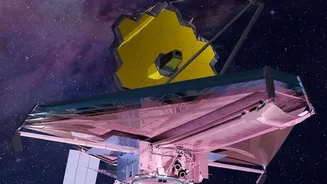
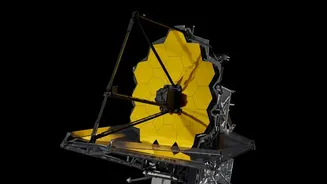
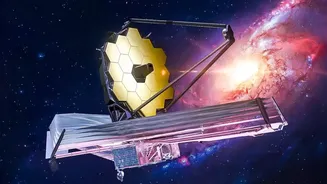
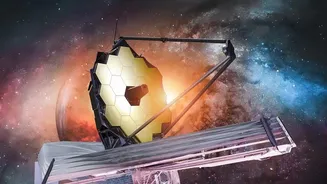
To understand this discovery, we have to travel back in time. Not just a few years, but over 13 billion years. The JWST is uniquely equipped for this journey. Its powerful infrared instruments can capture faint light that has travelled across the vast
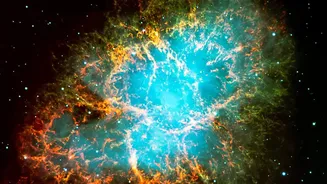
expanse of space and time, allowing scientists to witness the universe's infancy. This period, roughly from 400 million to 1 billion years after the Big Bang, is known as the 'Epoch of Reionization'. It was a transformative era when the first stars and galaxies lit up the cosmos, burning away the primordial fog of neutral hydrogen gas and making the universe transparent, as it is today. Every discovery from this epoch is a crucial clue in the story of our cosmic origins.
Meet the Cosmic Power Couple
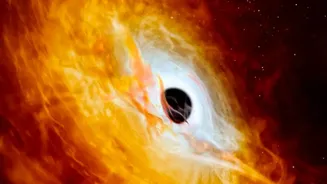
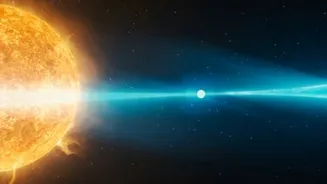
In a recent study, a team of astronomers pointed the JWST and the Gemini North telescope towards a distant point of light and found something astonishing. Not one, but two intensely bright objects, officially named J1602+4228AB, but nicknamed Nāpōwawāʻenakaulua. These are quasars—incredibly luminous beacons powered by supermassive black holes actively feeding on surrounding gas and dust. The light from this pair is so old that we are seeing them as they existed a mere 900 million years after the Big Bang. What's truly stunning is their scale and proximity. The two black holes weigh in at an estimated 1.5 billion and 400 million times the mass of our sun, respectively, and are separated by just 18,100 light-years—a cosmic stone's throw. This makes them the most distant and compact quasar pair ever found from this early era.
Rewriting the Rules of Growth
Finding such massive black holes so early in the universe presents a major puzzle for astronomers. According to lead researcher Silvia Onorato of NSF's NOIRLab, 'There is no definitive theoretical explanation for how a single one of these giant quasars exists so early in the age of our universe, much less two.' The discovery challenges the leading theories of black hole formation. One model suggests black holes start as 'light seeds' from the remnants of early stars and grow slowly over billions of years. But these behemoths didn't have that kind of time. This finding lends weight to the 'heavy seed' model, which proposes that black holes can form from the direct collapse of massive gas clouds, allowing them to start big and grow fast. The presence of a pair also strongly implies that two galaxies recently merged, a chaotic process that would have funnelled enormous amounts of gas toward the black holes, causing them to light up as quasars.
A Challenge to Modern Cosmology
This discovery isn't just about two objects; it's about the environment they grew in. Finding a pair this massive and close suggests they formed in an exceptionally dense part of the early universe, where galaxy collisions and mergers were frequent. Such regions are the cosmic nurseries where the largest structures in the universe are born. The Nāpōwawāʻenakaulua system serves as a unique laboratory for understanding how the first massive galaxies assembled through these violent, powerful interactions. While it is expected that these two supermassive black holes will eventually spiral inward and merge, that event—if it happened—occurred billions of years ago from our perspective. The light from that potential collision has not yet reached us. For now, what we see is a snapshot of a pivotal moment in cosmic history that defies our current models.