


More Than Just a Walk With Poles
Nordic walking, which originated in Finland as a way for cross-country skiers to train in the summer, is far more than just a stroll with stability aids. Unlike trekking poles used for balance on hikes, Nordic walking poles are designed for propulsion.
The fundamental goal is to use the poles to push yourself forward, transforming a simple walk into a dynamic, full-body exercise. When done correctly, it engages up to 90% of your body's muscles, compared to about 50% with regular walking. This increased muscle engagement turns every step into a comprehensive workout for your legs, core, and, most importantly, your upper body.
The Upper-Body Powerhouse
The real magic of Nordic walking lies in what happens above your waist. By actively pushing off the poles, you engage your arms, shoulders, chest, and back muscles. This doesn't just tone your upper half; it significantly boosts the intensity of your workout. Research shows Nordic walking can burn up to 67% more calories than regular walking at the same pace. This is because you are distributing the effort across your entire body, which not only increases your heart rate but can also make the exertion feel less strenuous. It’s a cardiovascular workout and a strength session rolled into one, improving posture, building core strength, and reducing strain on your neck and shoulders.
Getting the Movement Right
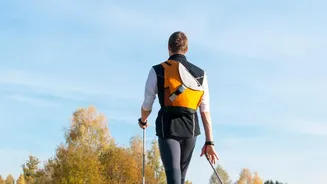
Mastering the upper-body technique is key to unlocking these benefits. The movement should be a fluid, natural swing originating from the shoulder, not the elbow. Your arm should move in opposition to your leg, just like in regular walking (left arm forward with right leg, and vice-versa). Here’s how to nail the technique: keep your arms relatively straight and swing them forward to about handshake height. As the arm swings back, plant the pole at an angle behind you, roughly between your feet. Push firmly through the pole and special glove-like strap. The most crucial part is the follow-through: as your arm extends fully behind you, open your hand to release the grip on the pole, letting the strap do the work. This 'push and release' motion ensures maximum muscle engagement and propulsion.
Common Mistakes to Avoid
Many beginners make a few common errors that limit the effectiveness of their workout. One is planting the poles too far in front of the body, which acts as a brake rather than a propeller. Another is bending the elbows too much, which puts the effort into the smaller bicep and tricep muscles instead of the large muscles of the back and shoulders. A tight, constant grip on the pole handle is also a mistake; the technique relies on opening the hand at the back of the swing to allow for a full range of motion. Finally, avoid hunching over. Keep your chest lifted and your shoulders relaxed and down to maintain good posture and allow for a free arm swing.
Choosing Your Tools for Success
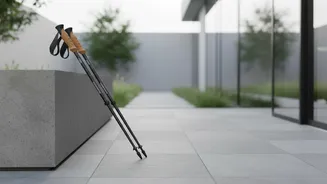
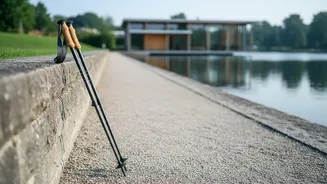
You can't get the upper-body movement right without the right equipment. Nordic walking poles are distinct from hiking or trekking poles. They are lighter and have a specific glove-strap system that is essential for the push-off technique. When choosing poles, length is critical. A general rule is to select a pole where your elbow is at a 90-degree angle when you stand tall and hold the grip. Many poles are adjustable, which is great for beginners. Also, consider the material; carbon poles are lighter and better at absorbing vibrations than aluminium ones, reducing stress on your wrist and elbow joints.