




From Observation to Action
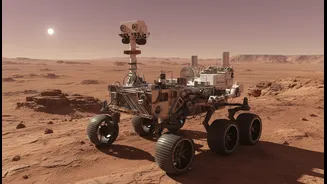
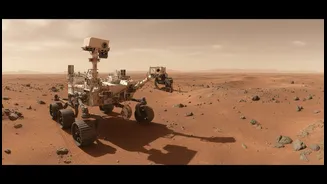
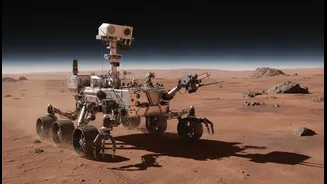
Our view of Mars has been shaped by a series of remarkable robotic explorers. From the microwave-sized Sojourner in 1997 to the car-sized Perseverance rover currently on the surface, NASA’s machines have been our eyes and ears on the Red Planet. These
missions have been wildly successful, revealing a world that once had flowing water and the essential ingredients for life. They've analysed soil, studied the thin atmosphere, and sent back breathtaking panoramas. But their primary role has been one of observation and data collection. Now, the paradigm is shifting. The next generation of robotics is being designed not just to look and learn, but to work. This marks a fundamental change in strategy: from exploring Mars as a distant scientific curiosity to preparing it as a future destination for humankind.
The STRIDE Forward
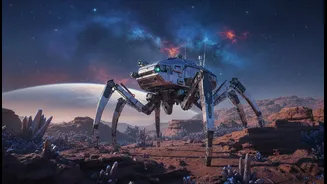
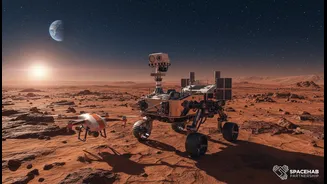
At the forefront of this new phase is NASA's Science Transport and Robotic Innovation for Deployment and Exploration (STRIDE) initiative. Announced in early July 2026, STRIDE is a public-private partnership aimed at developing the next generation of robotic mobility. NASA has awarded contracts to seven companies, including both established aerospace firms and innovative robotics startups, to design new systems. The goal is to create robots—both on the ground and in the air—that can access challenging terrain previously unreachable, travel greater distances, and transport scientific payloads. This initiative is about creating a more versatile and robust robotic workforce on Mars, one that can go beyond the relatively flat and safe landing sites chosen for previous rover missions.
The Rise of Autonomous Builders
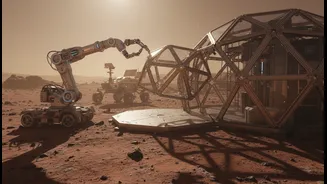
The long-term vision for this new robotic era is nothing short of science fiction made real: building the first human habitats before astronauts even arrive. Future missions will rely on autonomous construction robots to lay the groundwork for a sustained human presence. These machines will need to operate with a high degree of independence due to the significant communication delay between Earth and Mars. Concepts being developed include 3D-printing habitats using Martian soil, or regolith, as the primary building material. Projects like NASA's Automated Reconfigurable Mission Adaptive Digital Assembly Systems (ARMADAS) are already testing inchworm-like robots that can autonomously assemble structures from building blocks. This approach, known as in-situ resource utilization (ISRU), is critical. Using local materials is the only feasible way to build large-scale infrastructure, as the cost of launching every brick from Earth would be astronomical.
A Swarm of Possibilities
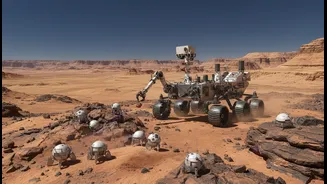
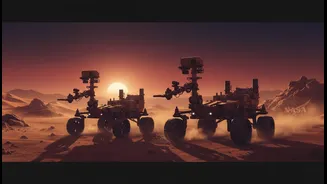
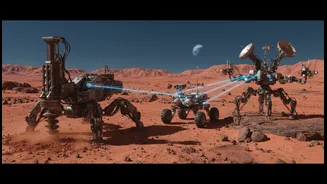
The future isn't just about single, large robots, but also about cooperative swarms. NASA's Cooperative Autonomous Distributed Robotic Exploration (CADRE) project is a technology demonstration involving multiple small, suitcase-sized rovers. These rovers are designed to work together as a team, exploring an area, communicating with each other, and making decisions without direct commands from Earth. This approach could dramatically speed up exploration and allow for simultaneous data collection from multiple points, something a single rover cannot do. Imagine a team of robotic prospectors scanning a wide area for water ice or valuable minerals, or a group of construction bots coordinating to assemble a solar farm. This swarm intelligence is seen as essential for tackling the complex, large-scale tasks needed to prepare Mars for human crews.
India's Martian Ambitions
This new era of Mars exploration is a global endeavor, and India is poised to play a significant role. Following the historic success of the Mars Orbiter Mission (Mangalyaan), which made India the first nation to reach Mars on its first attempt, the Indian Space Research Organisation (ISRO) is planning more ambitious follow-ups. Plans for a future mission include a lander and potentially a helicopter, inspired by NASA's Ingenuity. This proposed aerial vehicle would carry a suite of sensors to profile the Martian atmosphere. With a focus on cost-effective innovation, ISRO's expertise complements the global push toward making humanity a multi-planetary species. As NASA develops technologies for building habitats, India's advancements in robotics and exploration ensure it will be a key partner in the journey.