





What Exactly Is Open-Jaw Travel?
An open-jaw flight is a round-trip ticket that allows you to fly into one city and depart from another. The name comes from the shape the route makes on a map: two flight paths connected at your home base but with a gap, or an 'open jaw', between your arrival
and departure points abroad. You are responsible for covering this gap on your own, whether by train, car, or another mode of transport. For example, you might fly from Mumbai to Paris, travel through Europe by train, and then fly back to Mumbai from Rome. This is different from booking two separate one-way tickets, which is often more expensive. Instead, it is booked as a single itinerary, usually using the 'multi-city' search function on travel websites.
The Primary Benefit: No More Backtracking
The most significant advantage of an open-jaw itinerary is the time you save. Imagine a trip exploring multiple cities in a large country or continent. A traditional round-trip ticket would force you to waste a full day, or even more, travelling back to your original arrival city just to catch your flight home. Open-jaw travel eliminates this entirely, allowing you to plan a logical, linear route from Point A to Point B. This efficiency means more time enjoying your vacation and less time in transit. Instead of spending your last day on a train back to where you started, you can spend it exploring your final destination before heading to a nearby airport.
When Geography Is Your Best Friend
This strategy works best in regions with excellent and affordable ground transportation networks. Europe is a classic example, where travelling by train between countries is often faster and more scenic than flying. You could fly into Lisbon, travel across Spain and France, and fly home from Amsterdam. Similarly, a trip to the United States could involve flying into New York, driving or taking trains across the country, and departing from Los Angeles. In Southeast Asia, you could fly to Bangkok, travel through Cambodia and Vietnam, and fly home from Ho Chi Minh City. The key is that the 'jaw'—the overland portion—is a journey you actually want to take, turning a logistical necessity into a core part of your adventure.
How to Book an Open-Jaw Itinerary
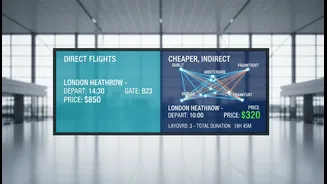
Booking an open-jaw flight is simpler than it sounds. Most airline websites and online travel agencies like Google Flights have a 'multi-city' or 'multiple destinations' option right next to the standard 'round-trip' and 'one-way' selections. To book, you simply select 'multi-city' and enter your flights as separate legs. For the first leg, you’ll enter your home airport to your first destination (e.g., Delhi to London). For the second leg, you’ll enter your final destination back to your home airport (e.g., Rome to Delhi). The search engine then pieces this together as a single itinerary. It is always wise to compare this price against a standard round-trip to ensure you are getting a good deal, but often the cost is comparable and sometimes even cheaper than two separate one-way tickets.
Potential Pitfalls to Consider
While powerful, this travel method requires careful planning. You must research the cost and logistics of the overland travel between your arrival and departure cities. A cheap flight deal can be quickly offset by an unexpectedly expensive high-speed train ticket. You should also be mindful of visa requirements if your overland journey takes you across international borders. Finally, while open-jaw tickets are often cheaper than two one-ways, they are not always cheaper than a promotional round-trip fare. Always compare the total cost of your trip—flights plus ground transport—before making a final decision. The goal is to save time and money, and a little bit of research ensures you accomplish both.