
The Standard Cosmic Story
The accepted age of the universe, 13.8 billion years, isn't a random guess. It's the cornerstone of the standard model of cosmology, known as the Lambda-CDM model. This framework explains everything from the afterglow of the Big Bang, called the Cosmic
Microwave Background, to the large-scale structure of galaxies. It's an incredibly successful model that posits the universe began with a hot, dense Big Bang and has been expanding and cooling ever since. This expansion is driven by a mysterious force called dark energy, while the gravitational glue holding galaxies together comes from unseen dark matter. Together, these two invisible components are thought to make up 95% of the cosmos, with ordinary matter like stars and planets accounting for just 5%.
A Radical New Timeline
Enter Rajendra Gupta, a physicist from the University of Ottawa, who has proposed a radical alternative. His model, known as CCC+TL, calculates the universe's age to be 26.7 billion years. The key to this much older cosmos is that Gupta’s model does away with the need for dark matter and dark energy. Instead, it proposes a hybrid theory that reintroduces two older, and largely dismissed, ideas: 'tired light' and 'covarying coupling constants'. This framework fundamentally rewrites our understanding of cosmic history and the forces that govern it.
Solving the 'Impossible Galaxy' Problem
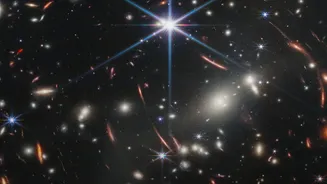
A major motivation for this new model comes from recent discoveries by the James Webb Space Telescope (JWST). The powerful telescope has spotted several galaxies in the very distant universe that appear surprisingly massive and mature. Dubbed 'universe breakers', these galaxies seem to have formed far more quickly than the standard 13.8-billion-year timeline would comfortably allow. According to standard cosmology, these galaxies are seen as they were just a few hundred million years after the Big Bang, which should have been too little time to grow so large. By nearly doubling the age of the universe, Gupta's model gives these 'impossible' early galaxies billions of extra years to form and evolve, making their observed maturity plausible.
Tired Light and Shifting Constants
The CCC+TL model has two main components. The 'Tired Light' (TL) theory, first proposed by Fritz Zwicky in 1929, suggests that photons (particles of light) lose energy as they travel across vast cosmic distances. This would make distant objects appear redder, something currently attributed solely to the expansion of the universe. The other part, 'Covarying Coupling Constants' (CCC), posits that the fundamental forces of nature, which are considered constant in the standard model, may have changed over time. In Gupta's model, the effects we attribute to dark energy and dark matter are instead explained by the evolution of these physical constants combined with tired light phenomena.
An Uphill Battle for Acceptance
While intriguing, the 26.7 billion-year model faces significant hurdles. The Lambda-CDM model remains the consensus because it successfully explains a wide array of cosmological observations, from the precise pattern of the cosmic microwave background to the abundance of light elements created after the Big Bang. The 'tired light' hypothesis, in particular, has been historically challenged because it fails to explain other observations, such as why distant objects don't appear blurry. Gupta's work is an attempt to revive and combine these ideas in a way that aligns with new data, but it is still considered a fringe theory. The scientific community demands extraordinary evidence for extraordinary claims, and this new model has a long way to go to convince the mainstream.