


The Old Story of Galaxy Growth
Imagine building a city, not by constructing large buildings, but by starting with individual houses, then slowly combining them into neighbourhoods, which then merge into towns, and only after a very long time, form a sprawling metropolis. For a long time, this
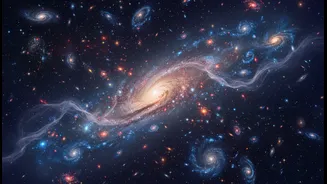
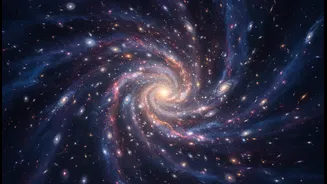
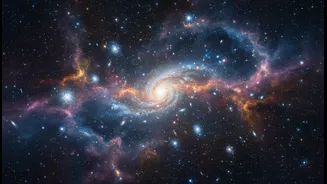
was the accepted model for how galaxies formed. Known as the 'bottom-up' or 'hierarchical-merger' model, it painted a picture of a slow, gradual process. In the early universe, just after the Big Bang, matter was mostly uniform hydrogen and helium gas. Gravity began to pull this gas into small clumps, which eventually ignited to form the first stars and tiny 'proto-galaxies'. The theory went that over billions of years, these small structures would collide and merge, slowly and progressively building the grand, complex spiral and elliptical galaxies we see today. A large, well-ordered galaxy like our Milky Way was seen as the product of a long and chaotic history of countless mergers, a process thought to take eons.
A Surprise in the Early Universe
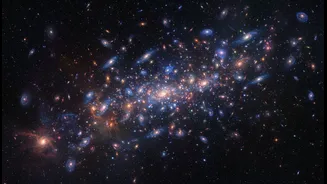
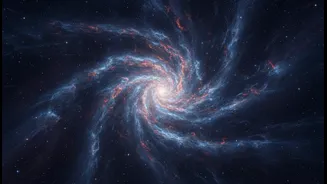
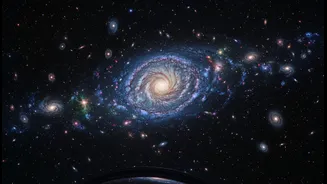
Recent observations have thrown a cosmic spanner in the works of this tidy theory. An international team of astronomers, using the incredible power of the James Webb Space Telescope (JWST), has discovered galaxies in the early universe that simply shouldn't exist yet, at least not in their observed form. New findings announced by researchers from Durham University detail the discovery of a galaxy with a well-defined 'nuclear disc' — a dense, rotating disc of stars at its centre — seen as it was over nine billion years ago. These are common in mature galaxies, but finding one so early is a shock. It suggests galaxies were developing complex internal structures much earlier than predicted. This isn't an isolated case. Since it began operations, the JWST has consistently found galaxies in the early universe that are far more massive, structured, and chemically mature than models allowed. It's like looking back at the 15th century and finding a fully built-out version of modern-day Mumbai, complete with skyscrapers and a metro system.
The Telescope That Sees Back in Time
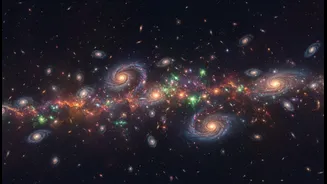
How is it possible to see something that happened nine billion years ago? The answer lies in the finite speed of light and the power of the James Webb Space Telescope. Because light takes time to travel across the vast distances of space, when we look at a very distant object, we are seeing it as it was in the past. The JWST is specifically designed to capture infrared light, which is the stretched-out light from the most distant objects in the cosmos. Its huge mirror and sensitive instruments allow it to peer back to the 'Cosmic Dawn', the period just a few hundred million years after the Big Bang when the very first stars and galaxies were lighting up the universe. In this case, the astronomers were able to identify not just the galaxy, but a feature known as a stellar 'bar' — a long structure of stars that acts like a cosmic conveyor belt, funnelling gas and dust to the galactic centre to fuel star birth and build new structures, like the nuclear disc they observed.
What This Means for Science
This discovery forces a major rethink of galaxy formation. The slow, steady merger model can't fully explain how such complex galaxies assembled so quickly. Scientists now have to refine their theories. It seems that internal processes, not just external mergers, play a crucial and very rapid role in shaping galaxies. The presence of stellar bars so early on suggests that galaxies can efficiently organise themselves from the inside out, maturing much faster than previously believed. This has knock-on effects for other cosmic mysteries. These dense central discs are thought to be the feeding grounds for the supermassive black holes that lurk at the heart of most large galaxies, including our own. If these structures formed earlier, it could help explain how these black holes grew to be so massive, so fast. It's a classic example of a new discovery not just answering a question, but opening up a dozen more exciting ones.