

A Groundbreaking Discovery
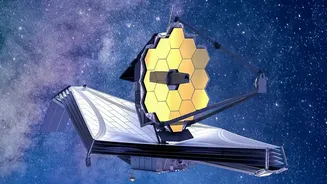
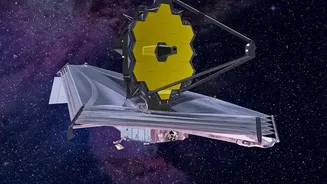
In a series of stunning observations, the James Webb Space Telescope has provided compelling evidence for the presence of water vapour on planets orbiting other stars. One recent discovery from September 2026, for example, detected water vapour in the inner
disk of a young star system called PDS 70, a region where rocky planets like Earth are thought to form. This is not the first time Webb has found water, with previous detections on worlds like the 'hot Jupiter' WASP-18b and the 'sub-Neptune' TOI-421 b, but finding it in a planet-forming zone is particularly exciting for scientists. These findings suggest that the essential ingredients for life as we know it could be common throughout the galaxy.
How to 'Smell' an Alien Atmosphere
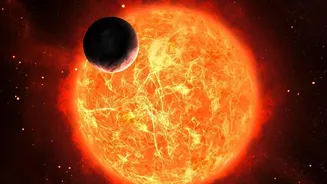
Detecting anything on a planet light-years away sounds like science fiction, but the JWST does it using a clever technique called transmission spectroscopy. When an exoplanet passes in front of its star from our point of view—an event called a transit—the starlight filters through the planet's atmosphere. Different chemical elements and molecules in the atmosphere absorb specific colours, or wavelengths, of light. The JWST's powerful infrared instruments are exquisitely sensitive to these changes. By analyzing the starlight before, during, and after a transit, astronomers can identify the unique chemical 'fingerprints' left behind, including the signature of water (H2O).
A Telescope Built for the Task
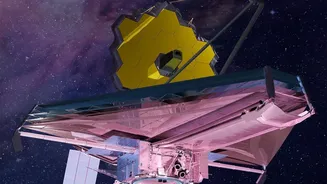
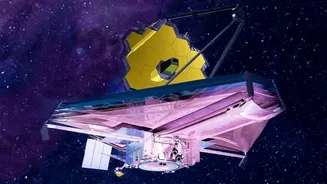
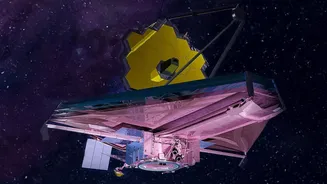
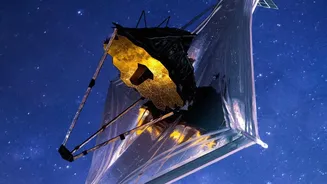
The reason the JWST is so good at this is because it was specifically designed to see the universe in infrared light. Earth's atmosphere blocks most infrared radiation, which is why a space-based observatory is crucial. Water molecules, along with other key indicators of atmospheric composition like methane and carbon dioxide, leave very distinct absorption patterns in the infrared part of the spectrum. This capability allows the JWST to succeed where previous telescopes, including the venerable Hubble, were limited. It can peer through cosmic dust and analyse the faint light from distant worlds with unprecedented clarity and detail.
Why Water Is So Important
On Earth, all life depends on liquid water. It's the universal solvent, facilitating the chemical reactions that make life possible. Because of this, the search for extraterrestrial life has long followed the mantra 'follow the water.' Finding water vapour in an exoplanet's atmosphere is the first crucial step. While it doesn't automatically mean there are vast oceans or swimming aliens, it does confirm that a fundamental building block for life is present. The discovery is especially significant for planets located in their star's 'habitable zone'—the orbital range where temperatures could allow liquid water to exist on a planet's surface.
Not Always Straightforward
The science is complex, and researchers are careful to rule out other possibilities. For instance, with the rocky exoplanet GJ 486 b, scientists detected water vapour but had to carefully consider whether the signal was coming from the planet's atmosphere or from cool spots on the star itself. These starspots can also contain water vapour, which could mimic a planetary signal. This highlights the meticulous work involved in confirming such a landmark discovery. It's a process of careful observation and ruling out all other explanations until the most likely conclusion remains.
The Dawn of a New Era
Each new detection of water on an exoplanet isn't just an isolated discovery; it's a data point that helps build a bigger picture of our galaxy. The James Webb Space Telescope isn't just finding water; it's helping scientists understand how planets form and evolve. By studying the atmospheres of a diverse range of worlds—from massive gas giants to smaller, rocky planets—we are beginning to understand the prevalence of key ingredients for life. These early findings are just a taste of what's to come, heralding a new era of exoplanet characterization that was once the domain of science fiction.