


First, What Is a Planetary Alignment?
When you hear "planetary alignment," it's easy to imagine planets lining up in a perfect, straight row like in a science-fiction movie. The reality is a little different, but no less spectacular. In astronomy, an alignment (or more accurately, a conjunction
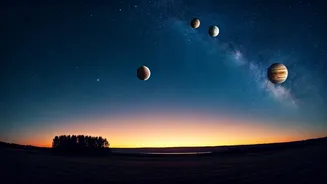
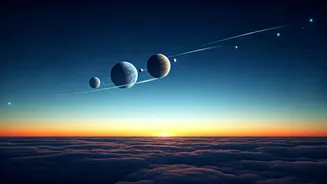
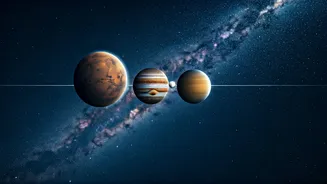
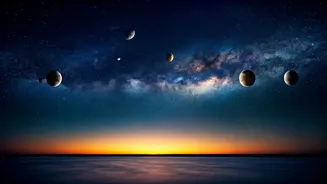
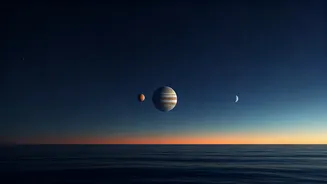
or grouping) occurs when several planets appear close to each other in a small sector of the sky, as seen from our vantage point on Earth. They aren’t physically close to each other in space—they remain millions of kilometres apart on their own orbits. Instead, their paths around the sun temporarily bring them into the same line of sight for us. Think of it as several distant city lights appearing clustered together from your window. This event offers a rare chance to spot multiple worlds at once without needing to turn your head.
A Celestial Parade of Planets
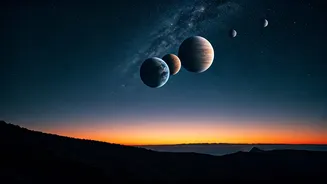
This particular alignment features a cast of five planets: Mercury, Jupiter, Mars, Saturn, and Uranus. The brightest star of the show will undoubtedly be Jupiter, which shines brilliantly and is easy to spot. Mars, with its distinct reddish hue, and Saturn, known for its rings (though you'll need a telescope to see them), will also be visible to the naked eye. Mercury is trickier; as it’s always close to the sun, it will appear low on the horizon just after sunset and can be a challenge to spot in the twilight glow. The fifth planet, Uranus, is the most elusive. Due to its distance, it is very faint and will require a good pair of binoculars or a small telescope, as well as a very dark sky, to be seen.
When and Where to Look in India
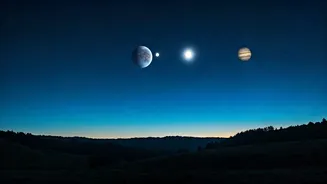
Timing and location are everything for successful stargazing. For this event, the best viewing window is shortly after sunset. Plan to be at your viewing spot about 45 minutes after the sun dips below the horizon. Look towards the western sky, where the sun has just set. The planets will be strung out in a line arcing upwards from the horizon. The key is to find a location with an unobstructed view of the western horizon, away from tall buildings or trees. More importantly, try to get away from the bright lights of the city. Light pollution from urban centres like Delhi, Mumbai, and Bengaluru can wash out fainter objects in the sky, making it difficult to spot planets like Mercury. If you can, a short drive to the city's outskirts will dramatically improve your viewing experience.
Your Simple Guide to Spotting the Planets
You don't need to be an expert to enjoy this. First, give your eyes time to adapt to the darkness—it takes about 15-20 minutes for your pupils to fully dilate. Avoid looking at your bright phone screen during this time. To easily identify what you're seeing, consider using a stargazing app on your phone, like Star Walk or SkyView. You can point your phone at the sky, and the app will show you exactly which planets and stars you're looking at. Start by finding the brightest object in the western sky after sunset; that will be Jupiter. From there, you can trace the line to find the other planets. Remember, planets don't twinkle like stars do. They shine with a steady, constant light, which is a great way to distinguish them from the surrounding stars.
Do You Need a Telescope?
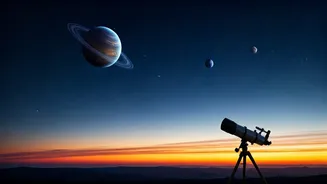
The great news is that you can enjoy the core of this celestial event with just your own eyes. Jupiter, Mars, and Saturn are all bright enough to be easily seen without any equipment. They will look like very bright stars. A good pair of binoculars will significantly enhance your view. With binoculars, you might be able to spot the faint disc of Jupiter and possibly even its four largest moons, which will look like tiny pinpricks of light right next to the planet. Binoculars will also be your best bet for catching a glimpse of Uranus, which will appear as a tiny, pale blue-green dot. A small telescope, of course, will reveal even more detail, allowing you to see Saturn’s iconic rings and maybe even some cloud bands on Jupiter. But don’t feel discouraged if you don’t have one; the simple act of seeing multiple planets strung across the twilight sky is a beautiful experience in itself.