






NISAR: The US-India Earth Watch
The most direct and significant collaboration to follow is the NASA-ISRO Synthetic Aperture Radar (NISAR) mission. This advanced Earth-observation satellite, a true partnership between the two space agencies, entered its science operations phase in early
2026. Data from its two radar instruments became publicly accessible in July 2026, marking a major milestone. For India, NISAR is a game-changer. It provides unprecedentedly detailed data on our planet's changing ecosystems, land surfaces, and ice sheets. The mission's ability to monitor agricultural changes, groundwater levels, and natural hazards like earthquakes and landslides is directly relevant to India's environmental and disaster management strategies. Tracking NISAR is not just about watching a satellite; it is about witnessing a powerful tool for national development and scientific research, built on a foundation of international cooperation.
Artemis Program: A Return to the Moon
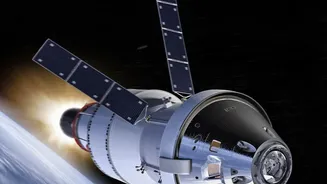
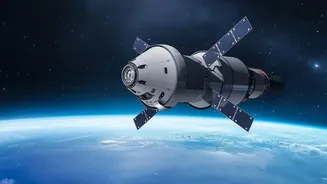
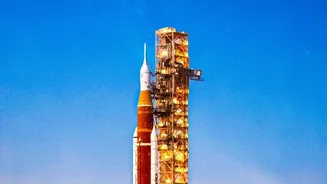
NASA's Artemis program, which aims to establish a sustainable human presence on the Moon, is another critical development. In April 2026, the Artemis II mission successfully sent four astronauts on a flyby around the Moon, the first time humans had ventured that deep into space since the Apollo era. This matters to India for several reasons. First, India is a signatory to the Artemis Accords, a set of principles for cooperation in lunar exploration. Second, NASA has formally invited ISRO to participate in its plan to build a permanent base on the Moon's south pole, the very region where Chandrayaan-3 made its historic landing. As ISRO develops its own Gaganyaan human spaceflight program and plans future lunar missions, the progress of Artemis offers a glimpse into the technologies, challenges, and collaborative opportunities that will define humanity's future on the Moon.
Europa Clipper: The Search for Alien Oceans
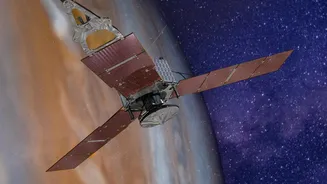
Launched in October 2024, NASA's Europa Clipper spacecraft is on a 2.9 billion-kilometre journey to Jupiter's icy moon, Europa. As of August 2026, it is well on its way, headed for an Earth gravity assist in December 2026 that will slingshot it towards the outer solar system. The spacecraft is scheduled to arrive at Jupiter in April 2030. Europa is believed to hide a vast liquid water ocean beneath its frozen crust—containing more water than all of Earth's oceans combined. While not a life-detection mission itself, Europa Clipper's 49 planned flybys will investigate whether this hidden ocean has the right conditions to support life. For a nation captivated by space science, from the discoveries of the James Webb Space Telescope to its own planetary missions, Europa Clipper represents one of humanity's most profound scientific quests: to find out if we are alone in the universe.
Mars Sample Return: A Future Ambition
Following the success of ISRO's Mangalyaan, Mars holds a special fascination. NASA's ambitious Mars Sample Return (MSR) mission aims to bring back the rock and soil samples currently being collected by the Perseverance rover. However, the program has faced significant budget and timeline challenges. In early 2026, the original plan was overhauled, and NASA is now evaluating new, more efficient approaches. The agency is expected to confirm a final design for the mission in the second half of 2026, with a potential return of samples in the 2030s. While its future is being redefined, the mission remains a critical one to watch. The samples collected by Perseverance from Jezero Crater may hold clues about whether life ever existed on Mars. For India and the world, the successful return of these samples would represent a monumental leap in planetary science, and the ongoing saga of the mission highlights the immense challenges of interplanetary exploration.