


A Star Is Born... Or Is It?
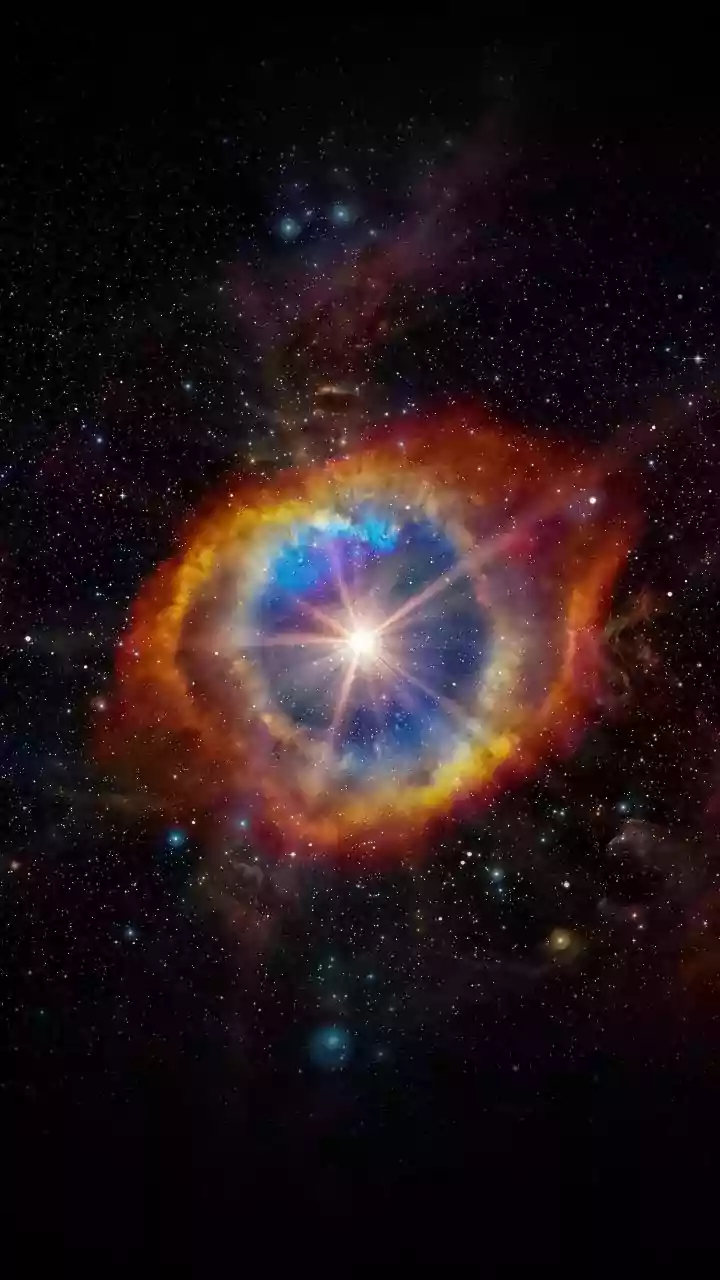
When observers across Europe and Asia first spotted the new light in the constellation Ophiuchus, they were witnessing the last supernova to be seen in our Milky Way galaxy with the naked eye. At the time, however, they believed it to be the birth of
a new star, a 'stella nova'. This sudden appearance was a profound puzzle. For centuries, the dominant scientific and philosophical belief, inherited from the ancient Greek philosopher Aristotle, was that the heavens beyond the Moon were perfect and, most importantly, unchangeable. A new star appearing in this supposedly immutable realm was, to put it mildly, a major problem for the established order.
Johannes Kepler's Meticulous Watch
While observers like Lodovico delle Colombe in Italy were among the first to record the event, it was German astronomer Johannes Kepler who would provide the most thorough study. Beginning his observations on October 17 from Prague, Kepler tracked the star for over a year until it faded from view. He did all of this without a telescope, as Galileo would only turn the new invention towards the skies years later. Kepler meticulously recorded the star's position and its changing brightness. His measurements demonstrated that the object showed no parallax—the apparent shift in position of a nearby object against a distant background. This was crucial proof that the 'new star' was not a local atmospheric phenomenon or something within the solar system, but was located far away, in the realm of the supposedly fixed stars.
Shattering the Perfect Heavens
Kepler published his findings in his 1606 book, 'De Stella nova in pede Serpentarii' ('On the New Star in Ophiuchus's Foot'). His work, along with that of contemporaries like Galileo, provided powerful evidence against the Aristotelian model of the cosmos. The supernova of 1604, coming just 32 years after another 'new star' observed by Tycho Brahe in 1572, delivered a one-two punch to the idea of perfect, unchanging heavens. By proving that change could and did occur in the distant stars, these events eroded the foundation of the old Earth-centered model and lent critical support to the Sun-centered, or heliocentric, system proposed by Nicolaus Copernicus a half-century earlier. It was a pivotal moment, shifting astronomy from philosophical doctrine to a science based on empirical observation.
The Modern View of a 400-Year-Old Explosion
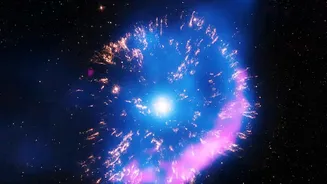
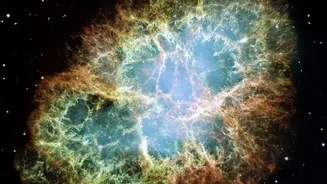
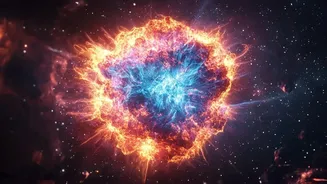
Centuries later, modern astronomy has revealed what Kepler could not have known. His 'new star' was actually a dying one: a violent explosion known as a Type Ia supernova. This occurs when a dense, compact star called a white dwarf accumulates too much matter from a companion star, becomes unstable, and triggers a runaway thermonuclear explosion. The remnant of this cosmic blast, located about 20,000 light-years from Earth, is still studied today. Observatories like NASA's Chandra X-ray Observatory and the Hubble Space Telescope have captured stunning images of a shell of expanding gas and dust, about 14 light-years wide, racing outwards at millions of miles per hour. These studies help astronomers understand the mechanics of these explosions, which are now used as 'standard candles' to measure the expansion of the universe.