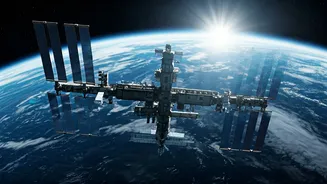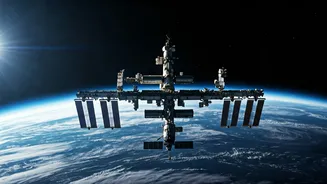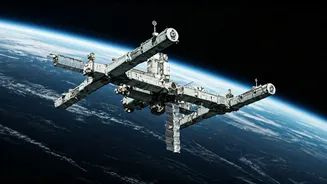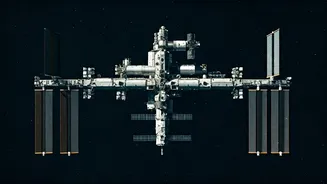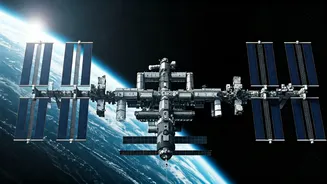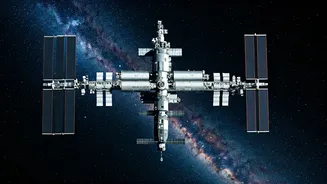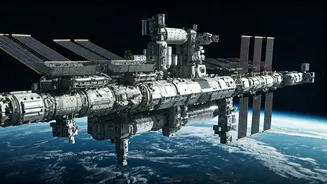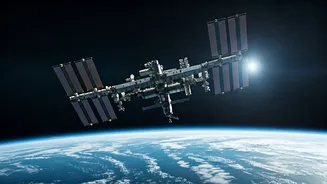





A Multibillion-Dollar Price Tag
The total cost of the International Space Station is estimated to be a colossal $150 billion. This figure includes the initial construction, decades of operation, and contributions from a consortium of five space agencies: NASA (United States), Roscosmos
(Russia), JAXA (Japan), ESA (Europe), and CSA (Canada). The United States has shouldered the largest portion of this cost. To put that number into perspective, it eclipses the budget of many other large-scale scientific projects, like the Large Hadron Collider. This international partnership, while a triumph of diplomacy, also added layers of complexity and coordination that contributed to the final cost.
The Hidden Costs on the Ground
A significant chunk of the station's budget was spent before a single component reached orbit. The initial research and development phase was immense. Scientists and engineers had to design and create technologies capable of sustaining human life in the harsh environment of space for long durations. This involved inventing new life support systems, radiation shielding, and power generation solutions. Each of the 16 primary pressurised modules and the vast truss structure had to be custom-designed, built, and rigorously tested on Earth to ensure they would function flawlessly in space, where repairs are incredibly difficult and expensive. This groundwork set the stage for everything that followed, but it came at a premium.
The Most Expensive Delivery Service
Simply getting to the ISS is one of the most significant cost drivers. Launching materials, supplies, and people into low Earth orbit is an extraordinarily expensive process. The assembly of the ISS alone required over 30 missions by vehicles like the Space Shuttle and Russian Proton rockets. Each launch carried a price tag in the hundreds of millions of dollars. Think of it as the ultimate delivery fee: every kilogram of food, water, scientific equipment, and spare parts has to be blasted into space at a speed of over 27,000 km/h, and that service doesn't come cheap.
Keeping the Lights On In Orbit
Building the station was just the beginning. The ongoing operational costs are substantial, running between $3 billion and $4 billion annually for NASA alone. This budget covers a wide range of necessities. It pays for the thousands of ground control staff around the world who manage the station 24/7, the continuous training of astronauts, and the constant resupply missions that ferry essentials to the crew. Furthermore, the station itself, a complex machine the size of a football field, requires constant maintenance, software updates, and occasional repairs to keep its more than 50 computers and life support systems running.
A Priceless Laboratory?
So, what has this massive investment bought? Proponents argue the ISS provides a unique platform for scientific research that's impossible to conduct on Earth. In its microgravity environment, over 400 experiments have been conducted, leading to breakthroughs in medicine, materials science, and our understanding of human physiology. Studies on protein crystals have aided drug development, and research into bone density loss in astronauts has provided insights into osteoporosis on Earth. The station has also spurred a commercial space economy and serves as a testbed for technologies needed for future missions to the Moon and Mars.