

The Universe We Thought We Knew
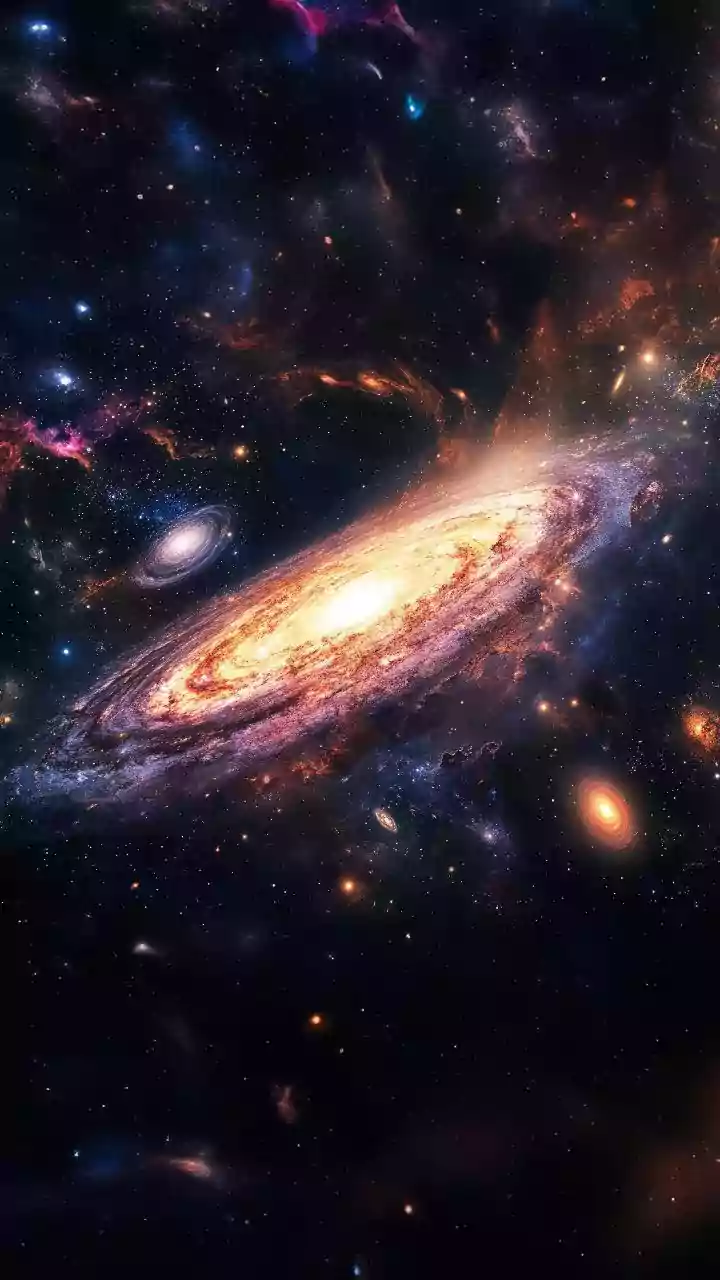
The current, widely accepted model of the universe is called the Lambda-CDM model (ΛCDM). It has been remarkably successful, explaining cosmic microwave background radiation, the large-scale structure of galaxies, and the accelerating expansion of the cosmos.
This model concludes that the universe began with the Big Bang approximately 13.8 billion years ago. A key part of this model involves two mysterious components: dark matter and dark energy. Dark matter provides the extra gravitational pull needed to explain why galaxies don't fly apart, while dark energy is the force believed to be driving the universe's accelerating expansion. Together, they are thought to make up about 95% of the cosmos, yet neither has ever been directly detected.
An Old Idea Gets a New Look
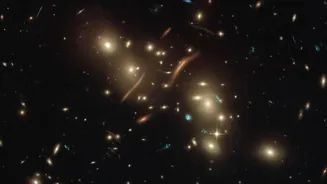
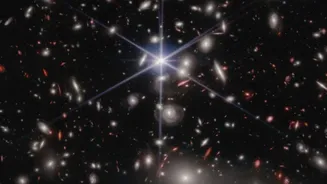
Despite its successes, the ΛCDM model has faced challenges. Recent observations from the James Webb Space Telescope (JWST) have revealed galaxies in the early universe that are surprisingly massive and mature. According to the standard model, these galaxies shouldn't have had enough time to grow so large. This 'impossible early galaxy problem' has led some scientists to reconsider alternative theories. One such researcher is Rajendra Gupta from the University of Ottawa, who has revived and combined two older ideas into a new hybrid model known as CCC+TL.
Tired Light and Shifting Constants
Gupta's CCC+TL model stands for Covarying Coupling Constants plus Tired Light. 'Tired Light' is a concept first proposed in 1929 by Fritz Zwicky. It suggests that the redshift we observe from distant galaxies—the stretching of light to longer, redder wavelengths—isn't just due to the expansion of space. Instead, it proposes that photons of light simply lose energy as they travel across vast cosmic distances. The second part, 'Covarying Coupling Constants', posits that the fundamental forces of nature might not be constant, but could change over cosmic time. By combining these two ideas, the model suggests that the universe's expansion isn't as fast as we think, which in turn significantly increases its calculated age.
Solving the 'Impossible' Galaxy Problem
The primary appeal of the CCC+TL model is that it offers a solution to the puzzle of those unexpectedly mature early galaxies. Under the standard ΛCDM model, a galaxy observed from the 'cosmic dawn' period might be just 300 million years old. However, in Gupta's 26.7-billion-year-old universe, that same galaxy would have had around 4.6 billion years to develop. This much longer timeline would make the existence of large, structured galaxies perfectly plausible. As Gupta puts it, 'Impossible early galaxies become predictable galaxies'. Furthermore, this model proposes that the effects we attribute to dark matter and dark energy could simply be the result of these slowly changing physical constants over billions of years.
A Universe of Skepticism
While intriguing, Gupta's theory is far from being accepted by the scientific mainstream. The 'Tired Light' hypothesis has been challenged for nearly a century for several reasons. For one, if light were scattered and lost energy, distant objects should appear blurry, which is not what we observe. Observations of supernova light curves also show time dilation—a stretching of time—that perfectly matches the predictions of an expanding universe but is inconsistent with static 'Tired Light' models. Critics also point out that while Gupta's model may account for large galaxies, it doesn't explain why these galaxies still appear young and bright, as would be expected of galaxies only a few hundred million years old. For now, the ΛCDM model, despite its own puzzles, remains the best-supported explanation for the cosmos we observe.