




The Classic Tale of a Starburst
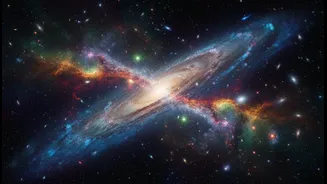
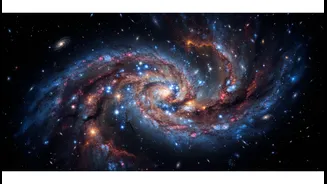
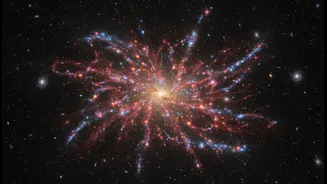
In the grand story of the cosmos, few events are as dramatic as a galaxy merger. When two galaxies, each containing billions of stars, are pulled together by gravity, the collision can trigger a spectacular event known as a starburst. The long-held theory
was that these were intense but relatively brief affairs. The immense gravitational forces would compress vast clouds of interstellar gas, kickstarting a furious wave of star formation at a rate hundreds of times faster than in a stable galaxy like our Milky Way. However, this stellar baby boom was thought to be its own undoing. The new, massive stars would live fast and die young, exploding as supernovae. The combined energy from these explosions and powerful stellar winds would blast the remaining gas out of the galaxy, effectively shutting down star formation and causing the galaxy to 'quench' or fizzle out. This process was believed to be a key phase in galaxy evolution, a short, brilliant flash before the galaxy settled into a quieter, older age.
A New Eye on the Universe
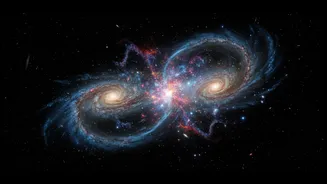
Enter the James Webb Space Telescope (JWST). With its unprecedented infrared sensitivity, Webb can peer through the dense veils of cosmic dust that have historically hidden the true nature of these star-forming regions from view. It provides a much clearer picture of what's happening deep inside these chaotic mergers. As part of a program called GOALS (Great Observatories All-sky LIRG Survey), astronomers are using Webb to study Luminous Infrared Galaxies (LIRGs)—galaxies that shine exceptionally brightly in infrared light, precisely because of intense star formation or active supermassive black holes often triggered by mergers. One of the key targets is a merging galaxy pair called II ZW 96, located about 500 million light-years from Earth. It serves as a perfect laboratory for testing theories of starbursts.
An Unexpected Cosmic Scene
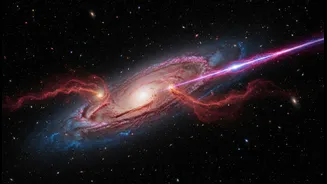
When Webb turned its golden eye toward II ZW 96, it didn't see a starburst on the verge of extinguishing itself. Instead, it saw something far more complex and resilient. The observations revealed that the furious star formation wasn't just confined to the galactic cores but was spread across bright tendrils connecting the two colliding galaxies. More surprisingly, the mechanisms that were supposed to shut down the starburst didn't seem to be working as predicted. Recent studies leveraging Webb's data on similar colliding systems suggest that the 'feedback' from young stars—the explosive stellar winds and supernovae—might not be as effective at clearing out gas as once thought. Instead of a quick burnout, it appears the starburst phase might be able to sustain itself for much longer, challenging the very definition of its lifecycle.
Rewriting the Cosmic Playbook
This discovery fundamentally challenges the established models of how galaxies evolve. If starbursts last longer, it means they play a much more significant and prolonged role in a galaxy's life. The 'quenching' process, where a galaxy stops forming stars, may be driven by different or more complex factors than just stellar feedback. Some recent Webb observations of other galaxies point to mergers being a primary cause of this shutdown, but the process appears more intricate than a simple on/off switch. The observations from colliding systems like II ZW 96 and others from the GOALS program are forcing astronomers to reconsider the balance of power within a galaxy. The interplay between gas accretion, star formation, and feedback from stars and supermassive black holes is proving to be a delicate and ongoing dance, rather than a single, dramatic event with a predictable end.
Why This Changes Our View of the Universe
The implications of longer-lasting starbursts are profound. It affects our understanding of how quickly galaxies build up their mass and how the chemical elements forged inside stars are distributed throughout the cosmos. If starbursts are more sustained, they would enrich the universe with heavy elements more steadily over time. Furthermore, it forces a rethink of how we interpret galaxies in the early universe. The JWST has already found surprisingly massive and mature galaxies at very early cosmic epochs, a finding that has puzzled scientists. If the engine of star formation in these early galaxies was more efficient and long-lived than models allowed, it might help explain how they grew so big, so fast. It's a reminder that even our most fundamental theories are subject to change when a new, more powerful tool allows us to see the universe in a new light.