



An Enemy Made of Glass
The first major hurdle is the lunar soil, or regolith. Unlike the sand and dust on Earth, which is worn smooth by wind and water, Moon dust is the product of billions of years of micrometeorite impacts pulverizing rock in a vacuum. The result is a layer
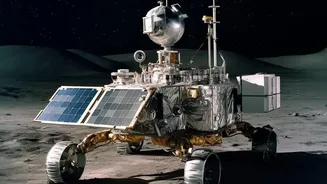
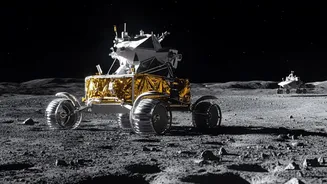
of fine, sharp, jagged particles, often compared to microscopic shards of glass. During the Apollo missions, this abrasive powder proved to be a menace. It clung to everything due to electrostatic charging from solar radiation, wore through layers of astronaut boots, clogged mechanisms, and caused seals on sample containers to fail. For a simple rover on a short-term science mission, this is a significant problem. For a complex construction robot intended to operate for months or years, it’s a potential mission-killer. These builder bots will have more moving parts—excavator arms, drills, and grippers—all of which are vulnerable to being infiltrated and ground down by this relentless, sharp dust.
Surviving the Temperature Gauntlet
The Moon’s lack of a substantial atmosphere creates another extreme challenge: a wild temperature swing. During its long, 14-day lunar day, surfaces at the equator can heat up to 127°C (260°F). Then, during the equally long lunar night, temperatures can plummet to a frigid -173°C (-280°F). This isn't just a matter of being hot or cold. These repeated, drastic cycles cause materials to expand and contract, which can lead to stress fractures and structural failure over time. For a robot, this is a nightmare. Batteries lose their ability to hold a charge in the extreme cold, electronics can overheat and fail in the direct sun, and lubricants can freeze solid, seizing gears and joints. While exploratory rovers have survived by using nuclear heaters or hibernating, construction robots will need to work for much longer periods. They require a constant power supply and robust thermal management systems—like advanced radiators and heat pipes—just to keep their internal components within a survivable temperature range.
Why Construction Bots Face a Bigger Threat
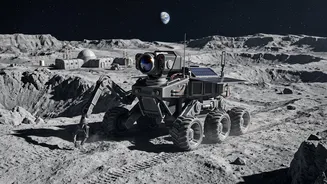
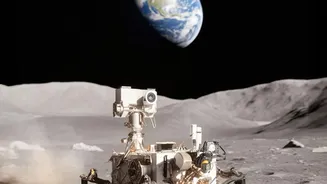
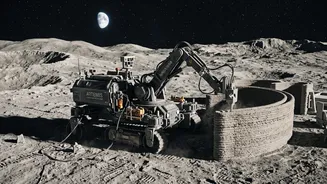
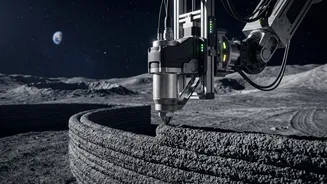
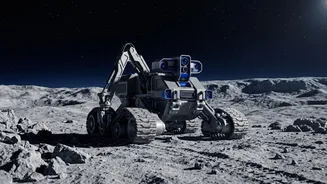
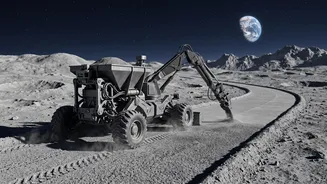
The reason these environmental factors are so critical for construction robots is a matter of scale and duration. An exploratory rover might travel a few kilometres and operate for a few months. A construction robot, however, is part of a much larger, longer-term project. The first jobs on the Moon will be repetitive, industrial tasks: levelling ground for landing pads, digging trenches for cables, and piling up regolith to be used as radiation shielding for habitats. These are earthmoving jobs that require robust, powerful machinery working continuously for extended periods. Every joint in a robotic excavator, every sensor on an autonomous hauler, and every solar panel used for power becomes a failure point under the constant assault of abrasive dust and thermal stress. Unlike an astronaut who can try to brush off a dusty suit, a robot's internal mechanisms can't be so easily cleaned, and a single failed seal could bring a multi-million dollar machine to a permanent halt.
Engineering Our Way to a Lunar Future
Solving these problems is at the forefront of space engineering. Agencies like NASA and ESA, along with private companies, are developing a suite of solutions. This includes creating new materials and specialized dust-repellent coatings, like 'Lunacoat', designed to protect sensitive surfaces such as solar panels and sensors. For the temperature challenge, engineers are designing novel gearboxes made from 'bulk metallic glass' that can operate in extreme cold without heaters, saving precious power. Advanced thermal control systems, including innovative loop heat pipes, are being developed to efficiently dissipate heat during the day and insulate components during the night. Furthermore, the robots themselves are being designed with these challenges in mind. Modular construction systems, like NASA's ARMADAS project, envision robots that can assemble structures from small, manageable parts, potentially even repairing and reconfiguring themselves, a critical capability when a human technician is millions of kilometres away. These advancements are crucial, as the success of future lunar bases depends almost entirely on the ability of robotic systems to do the foundational work before humans arrive.