
The Sun's Final Act
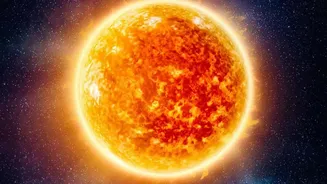
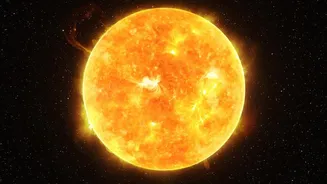
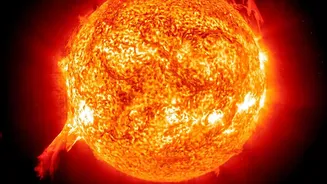
Everything we know about life on Earth is tied to the Sun, a middle-aged star that has been reliably burning for about 4.6 billion years. But it won't last forever. In roughly another 5 billion years, the Sun will exhaust the hydrogen fuel in its core.
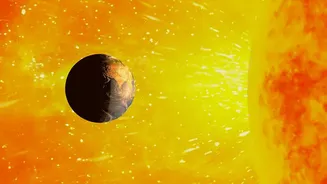
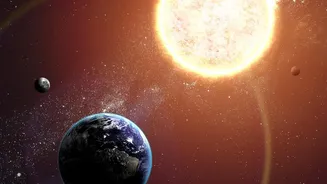
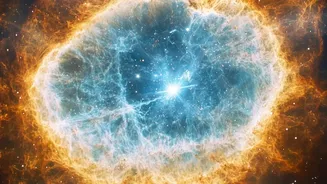
When this happens, it will begin a dramatic transformation, first swelling into a 'red giant'. In this phase, its outer layers will expand enormously, engulfing the inner planets: Mercury, Venus, and very likely Earth itself. Our planet will be vaporised, marking the end of its long history. After this destructive expansion, the Sun will shed its outer atmosphere, leaving behind a small, incredibly dense core known as a white dwarf. This stellar remnant will be only about the size of Earth but will contain roughly half of the Sun's original mass.
A New Gravitational Order
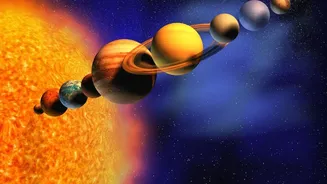
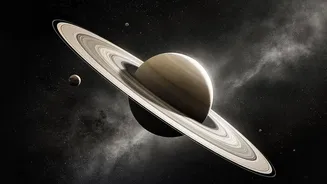
The birth of this white dwarf is the trigger for the chaos to come. The Sun losing half its mass in a relatively short cosmic timeframe is a cataclysmic event for the surviving planets. The force of gravity depends on mass, so when the Sun's mass is suddenly halved, its gravitational grip on the outer planets—Mars, Jupiter, Saturn, Uranus, and Neptune—weakens significantly. In response, these planets will drift into much larger, more distant orbits. This is where the recent study's simulations pick up the story. While the solar system will be much more spacious, it will also become far less stable. The Sun, now a feeble white dwarf, will no longer be the undisputed gravitational anchor. Instead, the giant planets themselves, particularly Jupiter and Saturn, will become the dominant forces shaping the system's destiny.
A Cosmic Game of Billiards
With the Sun's authority diminished, the subtle gravitational nudges that the giant planets have always exerted on each other become magnified. The new research simulated this future environment over immense timescales, revealing that the orderly dance of the planets will break down. The system transforms into what scientists describe as a 'cosmic game of billiards' or a 'pinball machine'. The orbits of the giant planets will begin to stretch, bend, and intersect in unpredictable ways. This gravitational instability, known as 'chaos' in orbital mechanics, means that the planets' long-term paths can no longer be precisely calculated. They will pull and push on each other, leading to increasingly erratic behaviour over millions and billions of years.
Planetary Eviction Notice
The most dramatic outcome predicted by these simulations is not necessarily a series of spectacular collisions, but rather planetary ejection. As the orbits of the giant planets become more eccentric and cross each other, a close pass between two of them could act like a gravitational slingshot. The powerful interaction could accelerate one of the planets to such a high speed that it escapes the white dwarf's gravitational pull entirely. According to the study, there is a strong possibility that at least one, and perhaps several, of the surviving planets will be flung out of the solar system to wander alone in the cold darkness of interstellar space. The simulations suggest this chaotic dance and subsequent ejections could take another 10 billion years to fully play out after the Sun becomes a white dwarf.