






The Ultimate Insurance Policy
Imagine being an astronaut strapped into a capsule atop a rocket filled with hundreds of tons of powerful fuel. While the launch is planned to perfection, what happens if something goes wrong? This is where the Crew Escape System (CES) comes in. Think
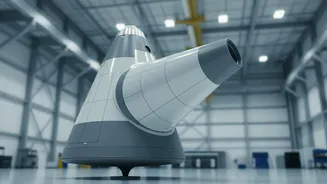
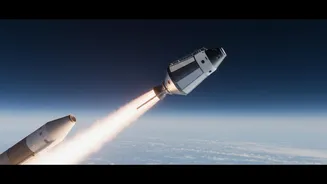
of it as a sophisticated, high-powered ejection seat, not for a single pilot, but for the entire crew capsule. The CES is an emergency measure designed to pull the crew module and its occupants to a safe distance from the launch vehicle in the event of a catastrophic failure on the launch pad or during the ascent. Its successful operation is non-negotiable for any human-rated space mission, making these tests a cornerstone of the entire Gaganyaan programme.
Anatomy of an Abort Test
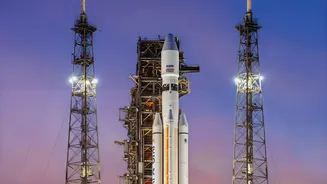
The latest simulations are part of a meticulously planned series of tests to validate the CES under various conditions. A key demonstration, the Test Vehicle Abort Mission-1 (TV-D1), was designed to simulate a failure during the ascent phase. In this test, a specially designed single-stage liquid-fueled rocket carried a full-scale, unpressurised version of the Gaganyaan crew module to a specific altitude. The goal was to mimic the conditions the rocket would face at an altitude of about 17 km while travelling at Mach 1.2, which is just over the speed of sound. At this precise moment, a simulated abort signal was triggered, initiating a rapid and complex sequence of events to prove the escape system works flawlessly when it's needed most.
A Flawless Escape Sequence
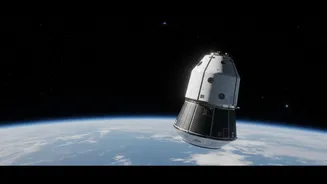
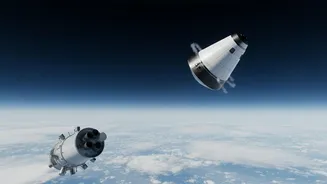
Once the abort was triggered, powerful, quick-acting solid motors on the Crew Escape System fired, propelling the crew module away from the main rocket. This initial burst of acceleration is crucial for getting the astronauts clear of any potential explosion. After reaching a safe distance and altitude, the CES jettisoned itself from the crew module. The module then began its descent, deploying a series of parachutes to slow down. This includes smaller drogue parachutes for initial stabilisation, followed by the main parachutes that ensure a gentle splashdown in the sea. For the TV-D1 test, the module landed in the Bay of Bengal, about 10 km from the launch site at Sriharikota, where recovery teams from the Indian Navy were on standby to retrieve it. The entire sequence, which lasted only a few minutes, was monitored by hundreds of sensors to confirm every system performed exactly as expected.
Building on a Foundation of Safety
This high-altitude test is not the first of its kind. It builds upon previous successful demonstrations, including the Pad Abort Test (PAT) conducted in 2018. The PAT was designed to verify the escape system's capability in case of an emergency right on the launch pad, before the rocket has even lifted off. In that test, the escape system fired to lift the capsule to an altitude of 2.7 km before it parachuted safely into the sea. Together, these tests—Pad Abort, In-Flight Abort, and Air Drop Tests for the parachute systems—form a comprehensive validation campaign. Each successful test provides ISRO engineers with vital data and increases confidence in the systems that will protect India's future Gagannauts.
The Path Forward to Manned Flight
With the successful completion of these critical abort tests, ISRO is moving steadily closer to the first uncrewed Gaganyaan mission. The plan involves a series of unmanned flights to test all systems in an integrated manner before the first crewed flight. The first uncrewed mission, Gaganyaan-1, is expected to carry the humanoid robot Vyommitra to validate the environmental control and life support systems inside the capsule. Following further successful uncrewed missions, India aims to launch its first astronauts into a low-Earth orbit of about 400 km for a three-day mission. This step-by-step, safety-first approach ensures that when Indian astronauts finally lift off, they will be flying in one of the safest spacecraft ever developed.