




The Lure of a Fading Spectacle
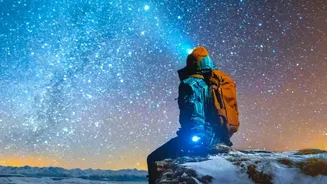
For a growing number of young explorers, the ultimate travel goal is a clear, unobstructed view of the Milky Way. This shimmering river of stars, a sight our ancestors took for granted, has become a rarity for most. With over 80% of the world's population
living under light-polluted skies, the natural grandeur of the cosmos is largely hidden. This loss has sparked a powerful counter-trend: astrotourism. It's a movement driven by a desire to reconnect with the universe, and India, with its vast, high-altitude deserts and protected reserves, has become a global hotspot.
Why Altitude and Darkness Are Key
To truly witness the Milky Way, you need to escape the luminous fog of artificial light that blankets our cities. High-altitude locations in the Himalayas, like those in Ladakh and Spiti Valley, offer the perfect conditions. At heights of over 10,000 feet, the air is thinner, colder, and drier, with less atmospheric haze to obscure the view. These remote regions are far from major urban centres, resulting in minimal light pollution. This combination creates a pristine canvas, allowing the faint light of distant galaxies and nebulae to shine through with astonishing clarity. Locations are often rated on the Bortle scale, a nine-level measure of sky brightness, with India's best spots achieving a Class 1 rating—the darkest possible.
India's Celestial Hotspots
Ladakh is the crown jewel of Indian stargazing. Hanle, a remote village in the Changthang region, is home to India's first official Dark Sky Reserve, established to protect its pristine skies for both tourism and scientific research. At an altitude of around 4,500 metres, the Indian Astronomical Observatory in Hanle is one of the highest in the world. Other Ladakhi locations like Pangong Tso, Tso Moriri, and the Nubra Valley also offer spectacular views, with the stark, beautiful landscapes providing a stunning foreground for astrophotography. Spiti Valley in Himachal Pradesh is another prime destination, a high-altitude desert renowned for its barren moonscapes and clear skies, attracting astro-tours to villages like Kaza and Langza.
A Quest for Connection and Content
The motivations behind this trend are twofold. For many, it's a profound, almost spiritual experience. Stargazing fosters a sense of awe, which studies show can reduce stress, improve mood, and make us feel more connected. In a hyper-connected world, the simple act of looking up offers a powerful way to disconnect from screens and find a new perspective. At the same time, the visual splendour of the Milky Way is undeniably 'Instagrammable'. The rise of accessible camera technology and smartphones with advanced night modes has turned astrophotography into a popular hobby. Young travellers are eager to capture and share these unique, awe-inspiring images, combining a desire for adventure with the currency of social media.
The Rise of a New Travel Industry
This interest has fuelled a boom in astrotourism. Companies like Starscapes and Stargazing Mumbai now offer curated tours and workshops, taking enthusiasts to prime locations and providing high-powered telescopes and expert guidance. This has also created sustainable, community-led opportunities. In places like Hanle, locals are being trained as 'Astronomy Ambassadors' to guide tourists, providing them with new livelihoods. The surge in visitors has been dramatic; after being designated a Dark Sky Reserve in 2022, annual visitors to Hanle reportedly jumped from around 5,000 to over 30,000. This new form of eco-tourism helps preserve the natural environment while boosting local economies.