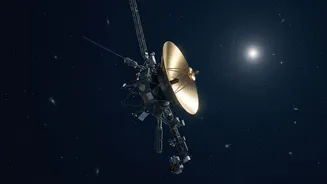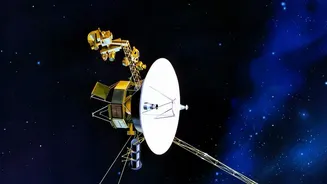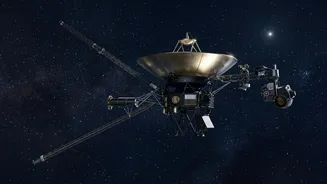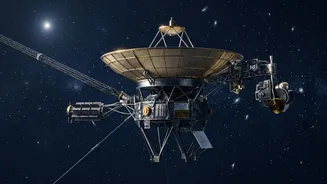

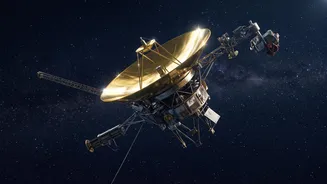
Launched nearly 50 years ago, Voyager 1 is about to make history again. On November 18, 2026, humanity's farthest emissary will become the first object we've ever built to reach a distance of one light-day from Earth.
A Journey Beyond Imagination
It’s a distance so vast it’s difficult
to comprehend. One light-day is how far a beam of light travels in 24 hours: approximately 25.9 billion kilometers. Put another way, it’s about 173 times the distance from the Earth to the Sun. On November 18, after a journey of 49 years, Voyager 1 will cross this monumental marker. For mission controllers on Earth, this new distance fundamentally changes their relationship with the craft. A command sent from the ground will take a full day to reach Voyager 1, and the subsequent confirmation will take another day to return, making a simple round-trip communication a 48-hour endeavor.
The Grand Tour's Unexpected Legacy
Voyager 1, along with its twin, Voyager 2, was launched in 1977 with a primary mission to conduct a 'grand tour' of the outer planets. It performed breathtaking flybys of Jupiter in 1979 and Saturn in 1980, using a gravitational slingshot to propel itself toward the unknown. Its original mission was a spectacular success, revealing volcanic activity on Jupiter's moon Io and the complexities of Saturn's rings. But its most enduring legacy began after that work was done. In 2012, Voyager 1 passed the heliopause—the boundary where the Sun's influence gives way to the interstellar medium—becoming the first human-made object to enter interstellar space.
Whispers from the Void
Keeping a nearly 50-year-old spacecraft functioning is a masterclass in engineering and ingenuity. Voyager 1 operates on just a few hundred watts of power from its decaying plutonium source, losing about four watts of power each year. To keep its science instruments running, NASA engineers have had to get creative. In September 2026, they executed a delicate maneuver nicknamed the 'Big Bang', shutting down some original hardware and switching to lower-power alternatives to conserve energy. The effort came just after a tense period in October 2026, when the spacecraft inexplicably went silent for 48 hours before its signal reappeared on its own, a reminder of the mission's incredible fragility.
Our Only Ears in Interstellar Space
Despite its age and dwindling power, Voyager 1 is still doing groundbreaking science. It is humanity's only direct probe of the interstellar medium, the vast sea of particles and radiation between star systems. Two of its original ten instruments remain active, listening to the 'hum' of plasma waves in deep space and measuring the magnetic fields of our galaxy. This data provides an unparalleled look at the environment our solar system travels through. Without the recent power saving fixes, NASA would have been forced to turn off another crucial instrument in 2027, effectively quieting one of our only voices in the cosmic wilderness.
A Golden Record and a Silent Voyage
Beyond its scientific mission, Voyager 1 carries a message of peace and curiosity: the Golden Record. This gold plated copper disk contains sounds and images selected to portray the diversity of life and culture on Earth, a 'bottle' launched into the cosmic 'ocean', as the late astronomer Carl Sagan described it. While its scientific instruments may fall silent in the coming decade, the spacecraft itself will continue its journey. Traveling at nearly $61,000$ kilometers per hour, it is heading in the general direction of the star Gliese $445$, which it will pass in about $40,000$ years.